
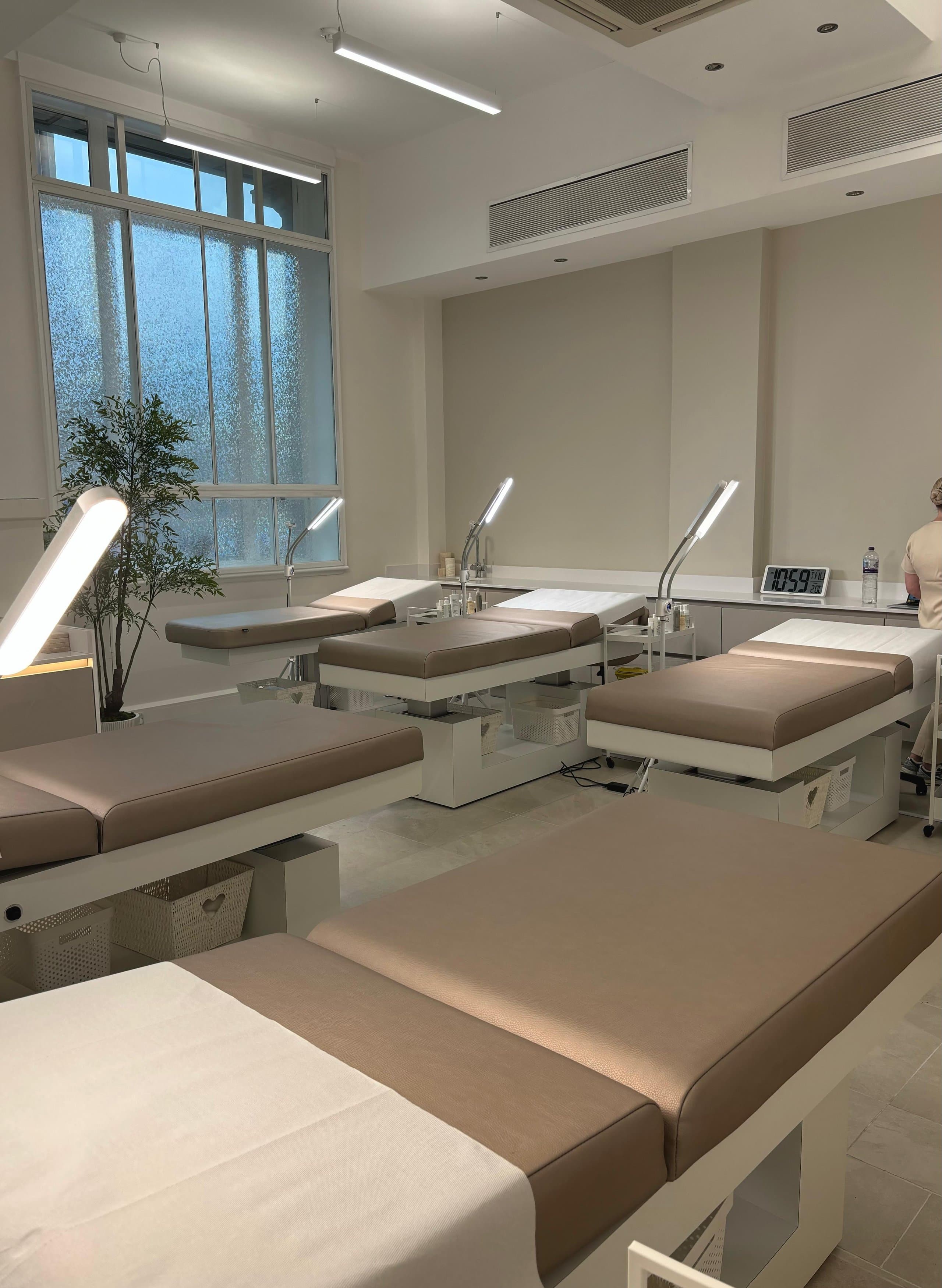

What is microneedling?
Microneedling is the practice of creating thousands of microscopic, controlled punctures in the skin with fine, sterile needles, usually delivered by a motorised pen gliding across the surface. Each micro-channel is invisible to the eye and heals within hours. But collectively, they send the skin a powerful message: rebuild.
The proper name, collagen induction therapy (CIT), describes exactly what happens next. The skin’s wound-healing cascade switches on, growth factors flood the area, and over the following weeks fibroblasts lay down fresh collagen and elastin, the scaffolding proteins that keep skin firm, smooth and bouncy. You are not adding anything to the skin. You are persuading the skin to renew itself, using machinery it has owned all along.
You will see the same treatment under several names, and they are worth untangling before we go further. Skin needling is the term UK qualifications tend to use. Percutaneous collagen induction (PCI) is the surgical literature’s name for it. Dermarolling usually means the older roller devices, and nano-needling means something genuinely different: tips so shallow they never reach the dermis, so no true collagen induction happens at all. One mechanism, several labels, and one clarifying question to keep in your pocket: how deep does it actually go?
That elegance is why microneedling has gone from niche to near-universal on UK treatment menus, and why it pairs so naturally with the rest of the professional toolkit, from chemical peels to dermaplaning. It is also one of the most misrepresented treatments in the industry, which is the other reason this guide exists: we train the people who perform it, and we would rather clients arrived informed than impressed.
A short history of needling.
Microneedling is young by skincare standards, and its origin story runs through three names worth knowing. In 1995, the New York dermatologists Orentreich and Orentreich described subcision: using needles beneath scars to free and rebuild them, proof that needles alone could remodel skin. In the mid-1990s the Cape Town plastic surgeon Des Fernandes took the leap that created the field, designing needle devices to trigger what he named percutaneous collagen induction, publishing the landmark paper in 2002 and establishing needling as a genuine alternative to laser resurfacing.7,8
The German inventor Horst Liebl put the idea into a rolling drum in 2000 (the original Dermaroller), the motorised pen era arrived around 2010, and the watershed for standards came in 2018, when SkinPen became the first microneedling device cleared by the US FDA, dragging a previously unregulated category up to medical-device evidence levels.1 Thirty years from clinical curiosity to one of the world’s most performed aesthetic treatments: not bad for a technique whose entire premise is a very small hole.
How microneedling actually works.
This is the section most articles skip, and it is the one that makes everything else obvious. Microneedling works because the human body has an extremely reliable response to injury, and because a needle can trigger that response while doing almost no harm.
The fractional principle
The first idea to grasp is fractional injury. When a pen passes over skin, it does not remove the surface. It punctures it, thousands of times, leaving the great majority of the skin between those channels completely untouched. Each channel is a few hundred microns wide at most, and the intact skin surrounding it supplies everything the repair needs: living keratinocytes to close the surface, blood supply, immune cells and signalling.
That is why the downtime is measured in days rather than weeks. Ablative resurfacing removes a whole layer and forces the body to rebuild a continuous wound. Microneedling asks it to repair a scatter of pinpricks in an otherwise healthy field, and skin is extraordinarily good at that. The epidermal barrier is substantially restored within hours, which is also why the window for enhanced product absorption is short, and why what goes onto the skin during and immediately after treatment matters so much.
The wound-healing cascade, properly
Skin responds to injury in three overlapping phases, and microneedling choreographs all three deliberately:
- Inflammation (day 0 to 3). Each channel triggers a brief bleed or a plasma leak. Platelets degranulate and release a signalling cocktail (platelet-derived growth factor, transforming growth factor beta, epidermal and fibroblast growth factors, vascular endothelial growth factor), the body’s “rebuild here” instruction. Neutrophils and then macrophages arrive to clear debris and keep the signal running. This is the short window of redness and heat clients notice.
- Proliferation (day 3 to 14). Fibroblasts migrate into the channels, multiply and start producing new matrix: collagen, elastin and the skin’s own hyaluronic acid. New micro-vessels form (neovascularisation), which is part of why skin looks better fed and brighter after a course. The collagen laid down first is mostly type III, the fast, temporary sort.
- Remodelling (weeks to months). Enzymes called matrix metalloproteinases carefully break down that provisional type III collagen while fibroblasts replace it with strong, organised type I collagen and rebuild elastin. Existing scar tissue is remodelled at the same time. This is where texture, scars and lines genuinely change, and why results keep improving for months after a course finishes.
Why “controlled” is the load-bearing word
Injury only builds skin inside a fairly narrow band. Too shallow and you never reach the fibroblasts that matter, so you get a facial with a nice glow and no remodelling. Too deep, too fast or too many passes, and you tip out of productive repair into genuine trauma: more inflammation, longer redness, pigment problems in melanin-rich skin, and in the worst cases visible track marks or scarring. The professional’s job is to sit deliberately in the middle of that band, and the variables they control are simple to list and hard to master: depth, speed of travel, number of passes, pressure, direction, and the endpoint they stop at.
One more mechanism is worth knowing because you will hear it quoted, usually badly. Fernandes and Liebl both argued that needling disturbs the skin’s natural electrical potential, creating a small demarcation current that helps recruit fibroblasts. It is an interesting theory rather than the settled reason microneedling works: the evidenced mechanism is the wound-healing cascade above.5,6 Being able to say which parts of a story are proven and which are proposed is what expertise sounds like, and it is why a professional device and proper training beat a cheap pen bought online.
Needle depths, zone by zone.
Needle depth is microneedling’s equivalent of peel depth: the single variable that defines result, risk and, in UK practice, who should be holding the pen. Modern pens adjust in fine increments, commonly 0.25mm at a time, and a good practitioner changes depth several times within one face.
| Depth | Reaches | Used for | What the skin does |
|---|---|---|---|
| 0.25–0.5mm | Epidermis, just into the top of the dermis | Glow, product absorption, early texture, delicate areas, first sessions | Light pink flush, settles in hours |
| 0.5–1.0mm | Upper dermis | Texture, pores, fine lines, general rejuvenation | Uniform pinpoint redness, warm for a day |
| 1.0–1.5mm | Mid dermis | Established scarring, deeper texture work, thicker skin zones | Pinpoint bleeding, 48 to 72 hours of redness |
| 1.5mm and beyond | Deeper dermis, on thicker skin only | Significant scarring and body work, in advanced or medical hands | Bleeding, swelling, longer recovery |
Depth is not a number, it is a map
Here is the detail that separates a technician from a practitioner: facial skin thickness varies enormously across one face. Eyelid and under-eye skin is among the thinnest on the body. The skin over the cheeks, forehead and chin is considerably thicker, and the nose is thick, sebaceous and stubborn. A single depth setting applied to a whole face is therefore either too timid where the work is needed or too aggressive where it will do harm.
So the professional works to a zone map: conservative around the orbital area and over bone, deeper across scarred cheeks, adjusted again on the nose, and stepped down on the neck and chest, where skin is thinner and heals less forgivingly than the face. They also reduce depth for a client’s first session, then build. A practitioner who cannot tell you what depth they are using on which zone, and why, is telling you something important.
Reading the endpoint
Depth is the setting; the endpoint is the evidence. For standard rejuvenation protocols the professional endpoint is uniform pinpoint erythema: an even, fine redness across the treated area, no more. In deeper scar work, fine pinpoint bleeding is expected and normal. What is never the goal is sheeting blood, bruising, or dragging the pen so it scratches: those are signs of too much depth, too much pressure or too little skill. More blood does not mean more collagen. It usually means more inflammation, which is the enemy of a clean result.
Depth also decides who should be holding the pen, because qualification and insurance expectations rise with it. That full picture, and how insurers draw the lines in UK practice, is in the scope section below.
What microneedling treats, honestly.
Microneedling is genuinely versatile, and it is also routinely oversold. So here is the version we teach: what it does well, what it does modestly, and what it does not do at all. Honest expectation setting is not a weakness in a treatment plan. It is the thing that produces delighted clients instead of disappointed ones.
| Concern | What to expect | How strong is the case |
|---|---|---|
| Atrophic acne scarring | Meaningful softening of rolling and boxcar scars across a course; ice-pick scars respond least | Strong. The flagship indication, supported by meta-analyses of randomised trials |
| Texture and roughness | Smoother, more even surface; makeup sits better; visible after two to three sessions | Good, and highly consistent in practice |
| Enlarged pores | Pores look refined because the skin around them thickens and smooths, not because they close | Modest. Real, but the most overclaimed benefit in the category |
| Fine lines and early laxity | Softened fine lines, firmer feel, a fresher look; deep static folds are unchanged | Moderate. Better with courses and maintenance |
| Post-inflammatory pigmentation and dullness | Brighter, more even tone as renewal disperses uneven pigment | Moderate, and it pairs well with pigment-focused home care |
| Melasma | Sometimes used cautiously as an adjunct in advanced or medical settings; aggressive needling can worsen it | Mixed and conditional. Never a first move |
| Stretch marks (striae) | Improved texture and colour across a longer course; older white striae respond more slowly | Reasonable, and an established area of body practice |
| Significant sagging or volume loss | Not the right tool. Refer or discuss alternatives honestly | No. Say so plainly |
Three honest additions. Microneedling is not a treatment for active, inflamed acne: you would be needling through infection, so the professional answer is to calm the acne first and treat the scarring it leaves behind. It is not the first choice for rosacea-type redness, where LED and vascular treatments have more to offer. And on the body it earns its keep: neck, chest, hands, abdomen and thighs are all treated routinely with depths adjusted down for thinner areas, and SkinPen’s specific US clearance for neck wrinkles is a useful reminder that off-face work is well studied rather than improvised.2 One mechanical, drug-free treatment covering scarring, texture, ageing and tone: like peels, it rewards the practitioner who masters it properly rather than learns it shallowly.
Numbing and comfort.
The first question almost every client asks is whether it hurts, and the honest answer is: less than you fear, and the difference is mostly technique.
At shallow depths, most people describe a prickling, vibrating, slightly scratchy sensation. From roughly 0.5mm upwards, and certainly for scar work, treatments are performed with a topical anaesthetic cream. It sits on cleansed skin for around 20 to 30 minutes, sometimes under a light occlusive film to help it work, and it is then completely removed before needling starts. That last point is not fussiness: anything left on the surface will be carried into the micro-channels, and anaesthetic cream is not formulated to go there.
Sensation still varies across one face. Bone close to the surface makes the forehead, jawline, nose and upper lip feel sharper, while the cheeks are usually the easiest area. Good practitioners work with that: they warn you before the tender zones, adjust depth and speed, use a chilled or vibrating distraction where appropriate, and keep talking to you. Cool compresses and a soothing mask afterwards take the sting out of the first hour.
Two boundaries matter. Prescription-only anaesthetics and injected local anaesthetic belong to prescribers, not skincare practitioners, and a treatment that genuinely needs them belongs in a different setting. And comfort has limits worth respecting: large areas, broken skin and allergy history all change what is sensible, which is why the anaesthetic conversation belongs in the consultation rather than the treatment room.
And to kill the most persistent myth in the category: pain is not the mechanism. Discomfort tells you about nerve endings, not about collagen. A properly numbed, correctly performed treatment at the right depth builds exactly as much collagen as a heroic one. It just produces a client who comes back.
A treatment, step by step.
Demystifying the appointment itself, because informed clients are calmer clients, and trainees should know the choreography before they ever hold a pen:
- Consultation and consent. Skin and medical history, medication, healing history, scar mapping, Fitzpatrick assessment, contraindication checks and a clear conversation about realistic outcomes and session counts. Photographs are taken in the same light, at the same angles, on clean skin, every time: memory flatters and criticises in equal measure, and only images settle the argument.
- Preparation before the day. Many practitioners prescribe two to four weeks of simple, supportive home care first, and ask clients to pause retinoids and exfoliating acids for several days before treatment. Waxing, laser and peels in the area are spaced out beforehand too.
- Numbing. A topical anaesthetic sits for 20 to 30 minutes for most protocols beyond the shallowest depths, then is fully removed.
- Prep. Skin is cleansed, then disinfected; hair is secured; a sterile cartridge is fitted in front of the client (with SkinPen, the single-use lockout makes reuse physically impossible, which is worth watching for as a client).
- The passes. A sterile hydrating glide medium goes on, then the pen travels in controlled, overlapping passes, typically working in two directions across each zone so coverage is even, with depth adjusted zone by zone: deeper where scarring lives, shallower over delicate areas and bone. The pen is held perpendicular and allowed to do the work, never dragged. Uniform pinpoint redness, not bleeding, is the professional endpoint for standard protocols.
- Finish. Soothing, microneedling-appropriate serums (this matters: only properly formulated, ideally sterile products belong on open micro-channels), barrier protection, SPF and written aftercare. Nothing perfumed, nothing acidic, nothing improvised.
- Records. Depths per zone, passes, products, cartridge details, client response and the next review date, all written down. Unglamorous, and the first thing an insurer asks for.
Start to finish, expect roughly an hour, of which the needling itself is perhaps twenty minutes. Body areas take longer.
Aftercare, day by day.
Microneedling’s recovery is short, but it rewards being taken seriously, and clients appreciate knowing the script in advance.
- The first few hours. Skin is warm, pink to red, tight and a little tender, most like mild sunburn. Some people have mild swelling, particularly around the eyes and on the first treatment. Cool, clean and calm is the whole strategy.
- Day 1. Redness fades towards pink. Skin often feels dry and taut. Hands stay off, and only the products you’ve been given go on. Mineral makeup is usually permitted from this point if you need it, applied with clean brushes.
- Days 2 to 3. Pinkness settles. Skin can feel faintly rough, like fine sandpaper, and may flake lightly. That is renewal, not damage, and it must not be picked or scrubbed.
- Days 4 to 7. The flaking finishes and the famous glow arrives: brighter, smoother, better light. This is the point most clients decide to book the course.
- Week 2 onwards. Visible recovery is over and the invisible work continues. Actives are reintroduced gently, usually retinoids last, on your practitioner’s timetable rather than a guess.
The rules of the first 48 hours: no makeup until at least the next day, no actives (retinoids, exfoliating acids, vitamin C unless specifically prescribed), no gyms, saunas, steam rooms, pools or hot yoga, no deliberate sun and no sunbeds, nothing layered on top, clean pillowcase, clean hands, clean phone, and only the gentle products you’ve been given, because the micro-channels turn everything up. From day three life is normal, with one permanent addition: daily SPF, the bodyguard of every collagen investment.
And the honest “ring us” list, because good aftercare includes knowing what is not normal: spreading redness or heat after day two, yellow crusting or discharge, pain that increases rather than settles, a cold sore starting, or any lesion appearing in a line. None are common, and all are easier dealt with early, which is why you should never leave without a way to contact your practitioner.
Results, timelines and courses.
Microneedling is a slow-burn treatment sold in a fast-gratification industry, which is why expectations do most of the work. Here is the realistic timeline for one session:
- Week 1: the glow. Genuine, lovely and mostly hydration, circulation and fresh surface. Not yet collagen.
- Weeks 2 to 6: the real work. New collagen is being laid down and organised. Texture starts to change and skin feels firmer to the touch.
- Month 3: the first honest checkpoint. Remodelling from a course is well underway and photographs start to show what talk cannot.
- Month 6 and beyond: scar improvement and firmness continue to develop, then plateau. This is where maintenance decisions get made.
Which is why microneedling is prescribed in courses of three to six sessions, spaced six to eight weeks apart, with scarring often needing the upper end of that range and sometimes more. Afterwards, most clients maintain with a session every three to six months. Nothing about this is a sales structure invented by clinics: it is the remodelling timeline dictating the diary.
And how often should the whole cycle repeat? Less often than the internet thinks. Here’s how our founder answered exactly that question at a recent student Q&A, including for clients in their fifties and beyond:
The gym analogy is worth keeping: the session is the stimulus, but the collagen is built in the rest. Booking more frequently doesn’t buy faster results; it interrupts them. And one last piece of honesty: results are maintained, not permanent. You have built better skin, but skin carries on ageing, so the plan continues with home care, SPF and sensible top-ups.
Pens, rollers, stamps and RF.
Microneedling has a dirty secret: the treatment is only as good, and as safe, as the device and the hands holding it. The market is flooded with cheap pens of unknown sterility, inconsistent needle depth and zero clinical evidence. Professional devices exist precisely to remove those unknowns: engineered cartridges that cannot leak fluids back into the device, verified depth accuracy, sterile single-use needle heads and published clinical data.
The four device families
- Motorised pens. The professional standard. A disposable cartridge of very fine needles oscillates vertically at high speed while the practitioner glides across the skin, so needles enter and exit perpendicular. Depth is adjustable, usually in 0.25mm steps, and consistent under pressure on a good device.
- Rollers (dermarollers). The original format, and now largely superseded in professional practice. Because the needles rotate into and out of skin at an angle, they tear a slightly wider channel than they puncture, depth is harder to control, and reused home rollers blunt and harbour bacteria. Their historical importance is real. Their place on a modern professional menu is small.
- Stamps and single-area tips. Pressed vertically rather than glided, useful for small, precise areas such as individual scars, and common in medical hands.
- RF microneedling. A different treatment wearing similar clothes: insulated needles deliver radiofrequency heat into the dermis as well as mechanical injury. More powerful for laxity, more expensive, and firmly advanced or medical-adjacent. We give it a whole guide of its own: RF microneedling and Morpheus8.
What actually makes a device professional
Beyond the brand name, this is the checklist we teach students to apply to any device a rep puts in front of them: sterile, single-use cartridges, ideally with a lockout that makes reuse impossible; a proper fluid barrier so blood and serum cannot travel back into the handpiece, the real cross-contamination risk here; depth accuracy that holds under resistance, not just on the dial; consistent motor performance as the battery drains; regulatory status you can look up, whether UKCA or CE marking for the UK market or an FDA clearance behind the marketing; and real training and traceable consumables from the supplier, not a box from a marketplace.
At MSTA we train on, and recommend, two devices, and they happen to share a parent company (both now sit within the Crown Aesthetics family): SkinPen Precision and MicroPen EVO. Between them they cover the whole professional market, from medical clinics to ambitious solo aestheticians.
SkinPen: the benchmark.
SkinPen Precision holds a unique place in microneedling history: in 2018 it became the first microneedling device ever cleared by the US FDA, initially for improving facial acne scars in adults, with a further clearance for neck wrinkles added in 2021.1,2 That clearance matters because it forced a standard onto a previously unregulated category: validated engineering, documented sterility and real clinical evidence, with a dossier now spanning more than ninety validation studies.
The engineering is the quiet star. Every treatment uses a sterile, single-use needle cartridge with a patented sleeve that acts as a barrier against cross-contamination, and a lockout system that physically prevents a used cartridge from being fitted again. As a client, that means the hygiene argument is settled by design, not by trust. As a practitioner, it means you are holding the device the medical aesthetics world treats as the reference point.
SkinPen is unapologetically premium. The device and its consumables cost more than the market average, and we won’t pretend otherwise. What you are buying is the deepest evidence base in the category, engineering that protects you and your client, and a consumer brand so strong that, for many clients, SkinPen simply means professional microneedling. Clients search for it by name and will choose a clinic because it offers it. Few devices in aesthetics carry that kind of pull, and it is why SkinPen is our core recommendation, and why MSTA is proud to be the UK’s exclusive SkinPen training partner.9
MicroPen EVO: the accessible alternative.
MicroPen EVO is the answer to a fair question: what if you want professional-grade microneedling with a gentler startup cost? Launched by Eclipse in 2021 and brought into the Crown family in 2022, EVO is also FDA-cleared, for facial acne scars and neck wrinkles, and built like it means it: a cordless, aerospace-grade magnesium body, depth adjustment in fine 0.25mm increments, and a safety cartridge designed with active needle retraction.10
In our hands-on experience at the academy, EVO simply delivers: consistent, science-backed outcomes that stand confidently beside far pricier setups. Its positioning is deliberately more accessible: a lower entry cost for the device and consumables, which changes the early economics meaningfully for a solo practitioner or new clinic, and UK supply that welcomes Level 3 and Level 4 professionals as well as medics.
You will sometimes hear the split described as “SkinPen for medical professionals, EVO for aestheticians”, and as a picture of typical usage that’s broadly true. But to be clear: it is not a rule. Both devices can be used by qualified skincare professionals and medics alike. The difference is positioning and price, not permission.
Choosing between them, honestly.
Our straightforward guidance, the same we give students:
- Choose SkinPen if you want the category benchmark: the deepest clinical dossier, the strongest consumer brand, and a device clients actively search for. The premium price is the cost of owning the reference standard, and for many clinics it pays for itself in marketing pull alone.
- Choose MicroPen EVO if you want outcomes you can fully stand behind with a more accessible entry point: equally FDA-cleared for its indications, genuinely excellent in practice, and kinder to a young business’s cash flow.
There is no wrong answer between the two, which is exactly why we train on both. What we’d steer you away from, always, is the unverified bargain pen: in a treatment built on controlled injury, “probably fine” engineering is a risk neither you nor your clients should carry.
Other names worth knowing.
For completeness, names you’ll meet across the UK industry: Dermapen (the Australian-founded pioneer of the pen format), Dermaroller (the German heritage brand behind the original roller-based collagen induction), SQT bio-microneedling (a needle-free approach using natural sponge spicules, growing fast in UK clinics), and the ubiquitous low-cost online pens, which we’ve already given our honest view on. Knowing the landscape makes you a better adviser to your clients, whatever you practise with.
RF, nano-needling and PRP: the extended family.
Three spin-offs come up in every modern microneedling conversation, and a well-trained professional can place each one precisely:
- RF microneedling (devices like Morpheus8 and Potenza) delivers radiofrequency heat through the needles into the dermis, adding heat-driven tightening to mechanical collagen induction. More powerful for laxity and deeper remodelling; also pricier, warmer and firmly in advanced or medical-adjacent territory. Our full RF microneedling guide covers it properly, including honest pricing and downtime.
- Nano-needling uses ultra-fine tips that touch only the outermost epidermis: no dermal injury, no true collagen induction, but excellent for product infusion and gentle glow. Honest positioning: a lovely facial-adjacent treatment, not CIT. If a menu prices nano-needling like microneedling, that is a question worth asking.
- Microneedling with PRP (the famous “vampire facial”) applies the client’s own platelet-rich plasma during treatment to amplify the healing cascade. Because it involves drawing and processing blood, it lives with medical practitioners, and it carries handling and infection-control obligations that a beauty setting is not built for.
The pattern across all three: the core mechanism is the one this guide has already taught you. Master standard collagen induction properly and every variant becomes a footnote you can evaluate, rather than a mystery you can be sold.
What the evidence actually says.
Microneedling is unusually well-evidenced for an aesthetic treatment, and the honest summary goes like this. For atrophic acne scarring, the flagship indication, a 2020 meta-analysis in the Journal of the American Academy of Dermatology and a 2022 systematic review of randomised trials both support microneedling as an effective monotherapy, with visible improvement across studies, while noting that the degree of improvement varies and that combination approaches (including with chemical peels) often perform best of all.3,4
Beyond scarring, the dermatology reviews describe a wider and steadily growing evidence base: rejuvenation and texture, striae, transdermal drug delivery, and a good safety profile with mostly mild, short-lived side effects.5,6 At the device level, SkinPen’s FDA clearances rest on controlled trials for facial acne scars and neck wrinkles, inside a validation dossier its maker counts in the dozens of studies. And mechanistically, percutaneous collagen induction has been documented in the surgical literature since Fernandes’s 2002 paper.
Where evidence is thinner, say so. Very shallow cosmetic rolling, dramatic pore-size claims and most stacked-treatment marketing rest more on experience than trials. Melasma remains genuinely contested. The protocol details clinics argue about with such confidence, exact pass counts, ideal intervals to the week, the best finishing serum, are largely unsettled and rightly guided by experience. And studies vary so much in device, depth and scoring that comparing two of them is rarely as simple as headlines suggest. That balance, strong core and honest edges, is exactly how we teach it, and every key source is linked below.
Contraindications and risks.
Microneedling’s safety record in trained hands is genuinely good, and it stays that way because professionals respect the no-list.
When a professional declines, or postpones
- Active infection in the area: cold sores, impetigo, fungal infection, infected or actively inflamed acne, or any open lesion. Needling spreads what it passes through.
- Keloid or hypertrophic scarring history: a hard stop for many practitioners, and at minimum a conversation and a test area with medical input.
- Recent oral isotretinoin: a waiting period agreed with the prescriber. The old blanket six-month rule is being revisited in the literature, which is a reason to ask rather than to improvise.
- Pregnancy and breastfeeding: postponed as a precaution, largely because of the topical anaesthetic and the general principle of not testing the unknown.
- Impaired healing: poorly controlled diabetes, immunosuppression, active chemotherapy or radiotherapy to the area, or a bleeding disorder. Anticoagulant medication is depth-dependent and needs discussion.
- Skin conditions in flare: eczema, psoriasis, active rosacea flares, or a compromised barrier from recent peels, laser, waxing or sunburn.
- Melasma, as a caution rather than a ban, and unrealistic expectations, the most under-rated contraindication in aesthetics. If a client wants what the treatment cannot give, the professional answer is a better plan, not a deeper setting.
What can go wrong, and what prevents it
- Infection. Rare, and almost always traceable to non-sterile equipment, unsuitable products on open channels, tap water or contaminated pots, or a client touching healing skin. Documented transmission of blood-borne infection has happened at unlicensed premises reusing equipment, which is precisely why single-use cartridges and a proper fluid barrier are not optional extras.
- Post-inflammatory hyperpigmentation. The most relevant risk in Fitzpatrick types IV to VI, driven by inflammation rather than by needles as such. Prevented with conservative depth, gentle technique, calm aftercare and rigorous SPF.
- Track marks (tram-tracking) and scarring. Linear marks from dragging the pen, treating too deep for the zone, or working the same area repeatedly. Entirely technique-driven.
- Granulomas and milia. Granulomas follow products never designed to enter skin, which is the whole argument for microneedling-appropriate, preferably sterile serums. Milia are minor and usually self-limiting.
- Cold sore reactivation. Anything disturbing the perioral area can wake herpes simplex in people who carry it, which is why history is asked for and antiviral planning arranged with a prescriber where appropriate.
- Prolonged redness, swelling or bruising. Usually a depth or technique mismatch, managed with barrier repair and patience rather than more product.
Notice that every one of those is a choice the practitioner controls. The needle is rarely the problem; the system around it is everything, which is the entire argument for training with people who hold clinical standards. The sterile cartridge, barrier and traceability rules behind that system are set out in our infection prevention guide.
Seven myths, dismantled.
- “Microneedling thins the skin.” The opposite. Repeated collagen induction thickens the dermis over time, which is why skin feels firmer and more resilient after a course rather than more fragile.
- “You have to bleed for it to work.” No. Pinpoint bleeding is an expected sign at deeper scar-work depths, not a target in itself. Uniform pinpoint redness is the professional endpoint for most rejuvenation protocols, and excess bleeding usually means excess inflammation.
- “A home roller does the same job.” It does not. Home devices are deliberately shallow, they blunt with use, they are almost impossible to sterilise properly at home, and rolling tears wider channels than it punctures. Useful for product absorption at best; not collagen induction therapy.
- “It is not safe on dark skin.” Microneedling is frequently the preferred option for deeper Fitzpatrick types precisely because it does not target melanin with light or heat. What changes is the discipline around inflammation, not the eligibility.
- “It is basically a fancy facial.” A facial works on and just below the surface. Microneedling deliberately breaches the dermis to trigger a healing cascade. Different mechanism, different consent conversation, different aftercare, different qualifications.
- “One session will fix my scars.” One session begins the process. Scar remodelling is cumulative, and any practitioner promising transformation from a single appointment is selling rather than treating.
- “More often is better.” Remodelling needs rest. Treating every two or three weeks interrupts the phase that produces the result, which is why six weeks is the most frequent interval we teach.
Microneedling in combination.
Real skin transformation rarely comes from one treatment in isolation, and sequencing is where a practitioner becomes indispensable. The rule underneath all of it: combine to cover different mechanisms, never to stack trauma.
- With chemical peels. Surface renewal plus deep stimulation, sequenced across a plan, is one of the most complete approaches to scarring, texture and pigmentation. Sequenced, not layered: a medium-depth peel and a needling session are spaced apart, typically by a couple of weeks, so the skin only has one repair job at a time. (BioRePeel alongside microneedling is a particularly popular modern pairing.)
- With dermaplaning. A cleared, even surface makes needling smoother and serums more effective. Many practitioners dermaplane at a separate appointment shortly before, rather than in the same session, so the skin is prepared without being pre-irritated.
- With LED light therapy. Red and near-infrared light after needling is a gentle, well-tolerated way to support healing and settle redness, and one of the few things that genuinely belongs in the same appointment.
- With light- and energy-based treatments. IPL, laser and RF microneedling all have their place in a plan, spaced sensibly rather than piled up. Anything that heats skin needs its own recovery window.
- With targeted serums and home care. The micro-channels dramatically increase absorption, which is an opportunity and a responsibility: only properly formulated, ideally sterile products belong on freshly needled skin, nothing perfumed, acidic or improvised. Retinoids pause, then resume on a timetable. Daily SPF protects the whole investment.
Who can perform microneedling in the UK.
This is the question every aspiring practitioner asks, and the honest answer is that the UK does not currently have a single statute that says “this depth requires this qualification”. What it has instead is a web of qualification frameworks, insurers, device suppliers and voluntary registers that, in practice, draw remarkably consistent lines.
- Qualifications. Insurers typically expect a recognised Level 3 beauty or skincare qualification as a foundation, with microneedling-specific training on top. For deeper needling, the benchmark most often named is the Ofqual-regulated Level 4 skin needling award, because a regulated qualification is externally assessed rather than self-certified. If the difference between a CPD certificate, an accredited course and a regulated qualification is new to you, our guide to Ofqual, CPD and VTCT levels is the single most useful thing a new practitioner can read.
- Insurance. In the real world, your insurer is the closest thing to a regulator you will meet. Cover is written against named treatments and often against depths, so the honest question is never “am I allowed?” but “what does my policy cover, in writing?”. Treating outside it means treating uninsured.
- Device suppliers. Reputable manufacturers vet purchasers, require training and will decline to supply practitioners who cannot evidence qualifications. That gate is one of the quiet reasons professional microneedling has held its standards better than some neighbouring treatments.9
- Voluntary registers. Bodies such as the Joint Council for Cosmetic Practitioners publish public registers of practitioners and clinics with entry requirements and codes of practice. Nobody is obliged to join, which is exactly what makes a listing informative for clients.11
For completeness: the government has consulted on licensing for non-surgical cosmetic procedures in England and the picture may change over time, so the sensible habit for any practitioner is to check the current position with their insurer and local authority rather than rely on any article, including this one.
The practical takeaway: your scope is built from your qualifications, your insurance and your judgement, and it grows deliberately as you train. That is precisely how our course pathways are structured, and for existing professionals who need the regulated credential without repeating training they already hold, the Access to Brands conversion pathway exists for exactly that.
What it costs in the UK.
For clients: professional microneedling in the UK typically runs somewhere between £75 and £300 per facial session, with London at the top of that range, regional clinics often in the lower half, and courses of three to six sessions usually packaged with a saving.12 Larger or multiple areas cost more: neck and chest add-ons, hands, and body work such as stretch marks are priced by area and time. RF microneedling starts meaningfully higher again, as our RF guide sets out.
What should be inside that price: a proper consultation and medical history, photographs, a sterile single-use cartridge, aftercare products or clear instructions, and a practitioner trained and insured for the depth they are using. A price that undercuts everything around it is usually economising on something you can’t see, so ask three questions before booking: what device, what depth, and what happens if something does not settle.
For practitioners, the economics differ from peels in one important way: there is a device investment and a per-treatment cartridge cost, which is precisely the premium-versus-accessible decision the SkinPen and MicroPen EVO sections above unpack. On what you can charge, we will give you the only figure we are comfortable giving: practitioners typically charge £75 to £130 per treatment depending on where they are. We will not put a number on what you would earn, because that depends on your prices, your costs and your diary, and anyone promising you an income is selling rather than teaching. What the model does share with peels is its shape: course-based treatment plans, sensible session values and natural retail of aftercare, which is the business thinking built into our advanced pathway.
How to choose a practitioner.
Microneedling is a treatment where the operator matters more than the brochure. Same device, same client, two sets of hands, two completely different outcomes. If you are booking as a client, this is what to look for, and none of it requires any technical knowledge at all.
Beyond the six, a few questions do a lot of work. What depth will you use on my skin, and why? A professional answers in zones and reasons. What is the device, and can I see it? A professional names it happily. How many sessions do you think I need, and what will you not be able to change? A professional is comfortable listing the limits.
And the red flags, stated plainly: no consultation or medical history; a cartridge already fitted when you arrive; heavy discounting on a treatment that has an unavoidable sterile consumable cost; results promised from one session; before-and-afters that are clearly stock photography or wildly inconsistent in lighting; nobody to contact afterwards; and any practitioner who treats your questions as a nuisance. Skin is not a category where “probably fine” belongs.
Training in microneedling: the MSTA route.
Microneedling sits at the heart of modern professional skincare, and at the heart of our curriculum. Complete beginners learn it properly, on professional devices, inside Aesthetic Skincare For Beginners. Qualified practitioners deepen and formalise their practice through The Ultimate Skincare Professional and our Executive Courses. And because we are the UK’s exclusive SkinPen training partner, you learn the benchmark device with the people who know it best, taught hands-on at our Rodney Street and Chapel Street academies in Liverpool by clinicians who use it on real clients every week.
That last point is not a slogan. MSTA grew out of a working clinic: Kirsty Stevenson founded Model Standards, her Liverpool skincare clinic, in 2014, and it is still treating clients today. The academy followed in 2018, and more than 1,000 students and 500 launched careers later, the teaching still comes from the treatment room rather than from a manual. Everything in this guide, from depth mapping to the awkward conversation about melasma, is written the way we teach it because it is the way we practise it.

A working glossary.
The vocabulary of needling, in plain English. Bookmark this; it makes every device brochure and training manual instantly more readable.
- CIT: collagen induction therapy, the proper name for microneedling.
- PCI: percutaneous collagen induction, the surgical literature’s term for the same thing.
- Skin needling: the term used by UK regulated qualifications.
- Micro-channel: one needle puncture; microns wide, closed within hours.
- Fractional: wounding only a small share of the surface, leaving intact skin between the channels to lead the repair.
- Fibroblast: the dermal cell that manufactures collagen, elastin and hyaluronic acid.
- Type III and type I collagen: the fast, provisional collagen laid down first, then replaced with the strong, organised sort during remodelling.
- Erythema: clinical word for redness. Uniform pinpoint erythema is the usual professional endpoint.
- Pinpoint bleeding: tiny dots of blood, expected at deeper scar-work depths, never a target in itself.
- Track marks (tram-tracking): linear marks caused by dragging the pen or working too deep for the zone. A technique fault.
- Cartridge: the sterile, single-use needle head that clicks onto a pen. Never reused.
- Glide medium: the sterile hydrating serum that lets the pen move smoothly across skin.
- Nano-needling: ultra-shallow tips that never reach the dermis. Good for product infusion; not collagen induction.
- PIH: post-inflammatory hyperpigmentation, the darkening skin can produce after inflammation. The key risk to manage in deeper skin tones.
- Fitzpatrick scale: the I to VI classification of how skin responds to sun and how its melanin behaves under stress.
- Occlusion: covering a topical (such as numbing cream) to help it absorb.
Microneedling FAQs.
Does microneedling hurt?
With professional devices and correct technique, most clients describe superficial treatments as prickling or vibrating rather than painful. Deeper protocols are performed with topical numbing cream. Bonier areas like the forehead and jawline feel sharper than the cheeks. Comfort management is part of proper training, and one of the clearest differences between a trained professional and a bargain treatment.
How long is the downtime after microneedling?
Typically 24 to 72 hours of redness and sensitivity, a little like mild sunburn, then a day or two of tightness and fine flaking, with skin looking fresh within about a week. Most people go back to work the next day, which is a big part of microneedling's popularity.
How many sessions does a client need, and how often?
Collagen remodelling is gradual, so results build across a course: commonly three to six sessions, spaced six to eight weeks apart so each remodelling phase completes before the next stimulus, then maintenance at the same rhythm. At MSTA we teach six weeks as the most frequent sensible interval. Single sessions refresh; courses transform.
How long do microneedling results last?
The collagen you build is real and lasts, but ageing carries on, so results are maintained rather than permanent. Most clients hold their result with a session every three to six months plus good home care and daily SPF. Scar improvements tend to hold better than firmness.
Is microneedling safe for darker skin tones?
Yes, and it's often preferred over some light- and heat-based treatments for deeper Fitzpatrick types because it doesn't target pigment. The risk to manage is post-inflammatory hyperpigmentation, which rises with melanin and with aggression, so conservative depth, gentle technique and rigorous SPF matter more, not less.
What qualifications do I need to offer microneedling in the UK?
In practice, insurers typically expect at least a Level 3 beauty qualification plus accredited microneedling training, and device companies vet practitioners before supplying professional devices. Deeper needling is widely treated as advanced practice, with insurers asking for higher qualifications, commonly the Ofqual-regulated Level 4 skin needling award, or medical oversight.
What's better: microneedling or a chemical peel?
Neither; they're different tools. Peels renew chemically from the surface down, microneedling stimulates mechanically from within. They address overlapping concerns and are often sequenced together across a treatment plan. Our chemical peels guide covers the other half of that story.
Can I use a derma-roller at home instead?
Home rollers at very shallow depths mainly assist product absorption, and they carry real hygiene pitfalls: reused needles that blunt and drag, with no way to sterilise them properly at home. They aren't collagen induction therapy in any meaningful sense. If the goal is actual skin change, professional treatment is a different category of intervention.
What's the difference between microneedling and RF microneedling?
RF microneedling adds radiofrequency heat delivered through the needles into the dermis, combining mechanical collagen induction with heat-driven tightening. It can do more for laxity, at a higher price and with more medical-grade considerations. Traditional microneedling remains the evidence-rich workhorse for scarring and texture.
Is microneedling worth it for acne scars compared with laser?
Meta-analyses support microneedling as an effective monotherapy for atrophic acne scarring, and it's often preferred for deeper skin tones because it carries no light-energy pigmentation risk. Rolling and boxcar scars respond best; narrow ice-pick scars respond least. Severe scarring sometimes warrants laser or combination approaches in medical settings, so an honest practitioner assesses scar type first and refers when appropriate.
Does microneedling help with large pores?
Somewhat, and the honest framing matters. Microneedling doesn't shrink pores like a drawstring. It thickens and firms the skin around them and smooths the surrounding texture, so pores catch less shadow and look smaller. Expect refinement across a course rather than transformation.
Can I have microneedling if I have melasma?
Sometimes, cautiously, and never as a first move. Melasma reacts badly to inflammation, so aggressive needling can make it worse. In practice it is managed with pigment-calming home care first, with any needling kept conservative, well spaced and sun-protected, often in an advanced or medical setting. If deep needling is offered for melasma without that conversation, ask more questions.
Can microneedling be done on the neck, chest and body?
Yes. Neck, chest, hands, abdomen and thighs are all treated professionally, and stretch marks are a well-established off-face use. Skin is thinner on the neck and chest, so depths come down there, and body areas cost more because of the surface area. SkinPen holds a specific US clearance for neck wrinkles, which tells you the area is well studied rather than improvised.
How soon can I wear makeup or go back to the gym?
Makeup usually waits until the next day, and mineral makeup on clean brushes is the kinder first choice. Sweat, heat and friction wait longer: most practitioners ask for no gym, sauna, steam, swimming or hot yoga for 48 hours, because sweat on healing micro-channels is an infection risk. Your practitioner's aftercare beats any general rule.
How much does microneedling cost in the UK?
Most UK clinics charge between £75 and £300 for a single facial session, with London at the top of that range and courses of three to six sessions usually packaged with a saving. RF microneedling starts meaningfully higher. A price far below everything around it is usually economising on something invisible: cartridge quality, consultation time, training or insurance.
How do I choose a good microneedling practitioner?
Ask what depth they'll use and why, watch the sealed single-use cartridge being opened in front of you, expect a written consultation and medical history, check their qualifications and that their insurance covers that depth, look at their own before-and-after photos rather than stock images, and leave with written aftercare and someone to ring.
Where can I train in microneedling in the UK?
MSTA teaches microneedling hands-on at our Rodney Street and Chapel Street academies in Liverpool as part of our Ofqual-regulated pathways, and we are the UK's exclusive SkinPen training partner. Beginners start with Aesthetic Skincare For Beginners; qualified practitioners go deeper through our advanced pathway and Executive Courses.
References and further reading.
The clinical and regulatory sources behind this guide, including the FDA documents most articles cite second-hand. We read them so you don’t have to, but they’re all here if you’d like to.
- FDA De Novo classification DEN160029: SkinPen Precision, the first FDA-cleared microneedling device (2018). (source)
- FDA 510(k) K202243: SkinPen Precision clearance for neck wrinkles (2021). (source)
- Efficacy of microneedling as monotherapy for atrophic acne scars, meta-analysis, Journal of the American Academy of Dermatology (2020). (source)
- Microneedling monotherapy for acne scars: systematic review and meta-analysis of RCTs, Aesthetic Plastic Surgery (2022). (source)
- Litchman G, Nair PA, Badri T, Kelly SE, Microneedling, StatPearls, NCBI Bookshelf. (source)
- Iriarte C, Awosika O, Rengifo-Pardo M, Ehrlich A, Review of applications of microneedling in dermatology, Clinical, Cosmetic and Investigational Dermatology (2017). (source)
- Fernandes D, Percutaneous Collagen Induction: An Alternative to Laser Resurfacing, Aesthetic Surgery Journal (2002). (source)
- Aust M, Fernandes D et al., percutaneous collagen induction therapy, Plastic and Reconstructive Surgery (2008). (source)
- SkinPen Precision UK: provider requirements and education. (source)
- MicroPen EVO launch and FDA clearance announcement (2021). (source)
- Joint Council for Cosmetic Practitioners (JCCP): public register of practitioners and clinics. (source)
- UK microneedling price guides (consumer sources, 2025). (source)