

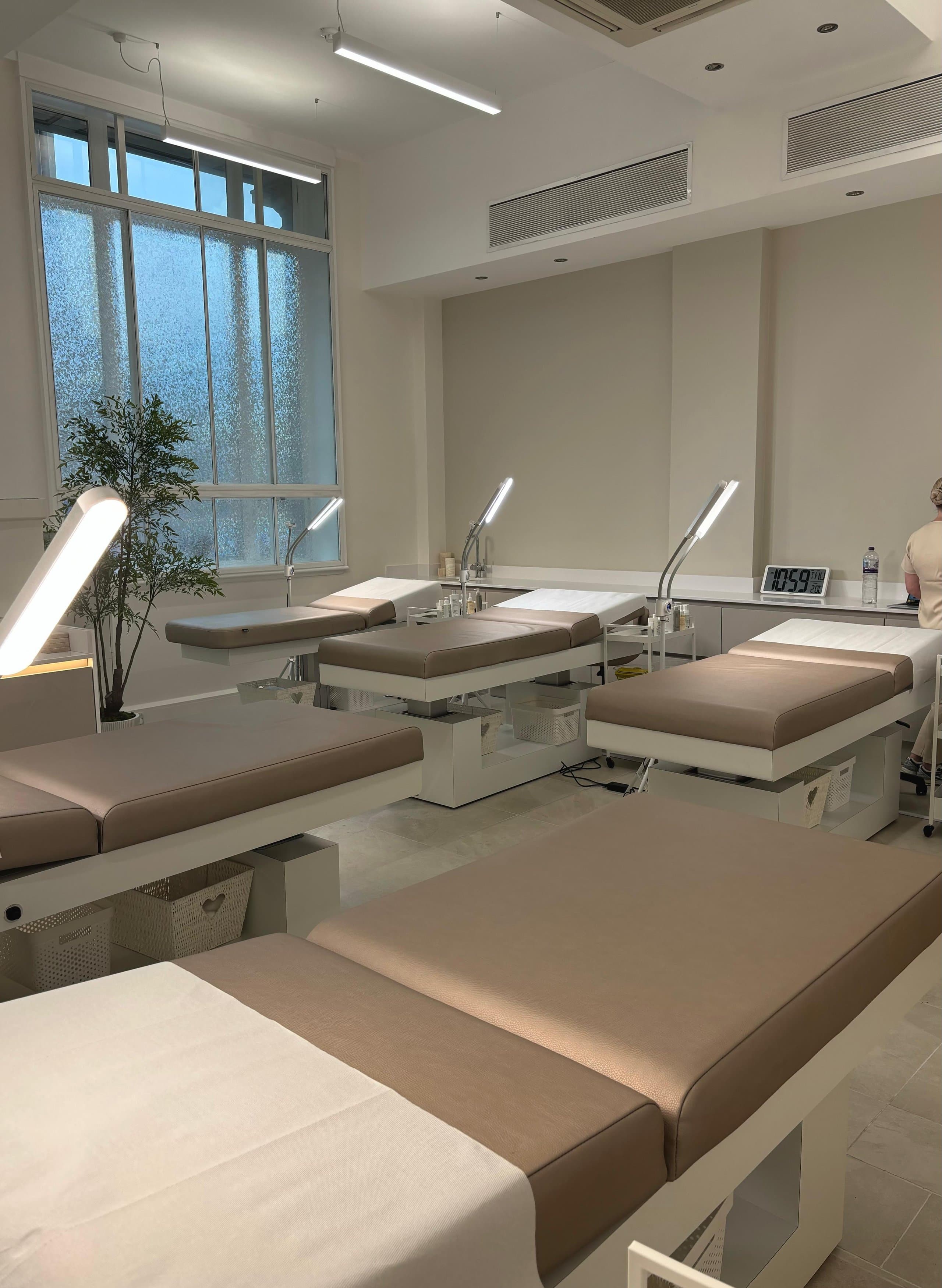

What is dermaplaning?
Dermaplaning is a manual exfoliation treatment in which a trained professional glides a sterile, single-use surgical blade across the skin at a shallow angle, removing two things at once: the outermost layer of dead skin cells, and the fine vellus hair most people call “peach fuzz”.
It is purely mechanical. No acids, no heat, no light, no needles. That makes it one of the gentlest treatments on a professional menu in terms of biological stress, while still delivering one of the most instantly visible results: skin that is smooth to the touch, brighter under light, and flawless under makeup, with effectively zero downtime.
You’ll meet it under other names. Blade exfoliation is the plainest. Epidermal levellingis what American aesthetics calls it, and it’s the most technically honest, because levelling the epidermal surface is exactly what happens. It is not a peel, because nothing chemical happens, and it is not hair removal in the epilating sense, because the follicle is untouched.
Unlike chemical peels or microneedling, dermaplaning doesn’t set out to remodel the skin’s deeper structures. Its genius is at the surface, and in what it makes possible for every treatment that follows it.
What the blade removes: two very different things.
Almost every argument about dermaplaning, including the famous one about hair, dissolves once you know exactly what a blade meets on its way across a face. There are two targets, and they behave completely differently.
The first is the stratum corneum: roughly twenty to thirty layers of flattened dead keratinocytes, held together by protein bonds called desmosomes.3 New cells take around a month to travel up from the deeper epidermis, flatten, die and shed, and that cycle slows with age, sun damage and dehydration. When it slows, cells that should have left accumulate: skin looks dull because a rough surface scatters light, texture feels grainy, and foundation clings to flakes. A blade held correctly lifts away the loose, ready-to-shed top of that layer and leaves living skin alone. That distinction is the entire safety case for the treatment, and it is also why frequency matters.
The second target is hair, and there are two kinds. Vellus hair is short, fine, soft and barely pigmented, without the central medulla thicker hairs carry.2 It aids thermoregulation and makes skin sensitive to light touch. Terminal hair is thicker, darker and medullated: scalp, brows, lashes, and the growth that appears in androgen-sensitive areas after puberty. Which kind a follicle makes is decided by genetics and hormones, several millimetres below the surface.
That distinction is what makes a practitioner sound like an expert. Dermaplaning is designed around vellus hair, and on vellus hair the results are reliably lovely. Where a face carries genuinely terminal growth, which is more common with polycystic ovary syndrome, around perimenopause and with some medications, a blade cuts it as any blade would: bluntly, and noticeably to the touch as it regrows. Nothing goes wrong. What goes wrong is failing to say so at consultation.
From surgery to selfie: a short history.
Dermaplaning’s family tree is more clinical than its Instagram fame suggests. Mechanical “planing” of the skin entered dermatology in the early 1950s, when surgeons popularised dermabrasion for scar revision: aggressive, effective and unambiguously medical. The gentle, blade-only descendant we now call dermaplaning evolved in aesthetics as practitioners realised the superficial layer alone could be refined, without the deep injury of true dermabrasion, for instant cosmetic payoff.
It has a quieter cultural lineage too: in Japan, facial shaving (kao-sori) has been a mainstream beauty ritual for generations, for exactly the reasons this guide describes. The third act began in the 2010s, when before-and-after videos made the instant glow one of social media’s favourite transformations. The technique didn’t change; the audience did.
How it works: blade, angle, technique.
The professional tool is a single-use, sterile blade (the classic choice is a surgical No. 10, sometimes the rounded 10R, or a purpose-made dermaplaning blade) mounted in a handle and held at roughly 45 degrees to taut skin. The practitioner works in small, feather-light strokes, section by section, against gentle skin tension.
One technical detail matters more than any other, and home users almost always miss it: the skin must be completely dry and degreased. A blade glides predictably on dry skin and skids across damp or oily skin, catching in some places and doing nothing in others. It is counter-intuitive to anyone raised on shaving foam, and it is the single biggest difference between the two activities.
Beyond that, four things separate a treatment from a face-shave:
- Angle and pressure control. Too steep or too firm and you irritate or nick; too shallow and you achieve nothing.
- Mapping, tension and stroke discipline. A deliberate sequence, each zone stretched correctly, short passes, never repeatedly over the same patch. The urge to “just go over that bit again” is exactly what training trains out.
- Knowing where not to go. Eyelids, lips, the rims of the nostrils, raised moles and skin tags, milia, and anything broken, inflamed or undiagnosed. Mapped before the first stroke, not after.
- Hygiene and assessment. Sterile blades, one use, every time, and a proper skin assessment first: active acne, inflammation, cold sores and certain medications all change the plan. This judgement is the real product of training.
There is a skill in stopping, too. Shine that reads as tightness, any stinging, or warmth that keeps building all mean the surface has had enough.
A professional treatment, step by step.
Here’s what actually happens in a well-run appointment, the version a client should expect and a trainee learns to deliver:
- Consultation and assessment. Skin and medical history, medication, a full contraindication check, and agreeing what today will and won’t do. Informed consent is signed here, not assumed, and notes and photographs are taken with permission.
- Double cleanse and degrease, so the skin is completely dry and oil-free.
- Sectioning. The face is worked in mapped zones, the free hand keeping each area taut. Most practitioners follow the same route every time, because a consistent sequence is how you know nothing was missed or treated twice.
- The strokes. Short, feather-light passes at roughly 45 degrees, always with fresh sterile steel, never across lips, lids or active blemishes.
- Finish and protect. A soothing application suited to the skin, then SPF. Many clinics follow with a hydrating mask, enzyme treatment or gentle peel.
- Aftercare, out loud and in writing. What to expect, what to avoid, and who to contact if something doesn’t look right. A verbal “you’ll be fine” is not aftercare.
Total time, around 30 to 45 minutes. One part is never routine, though: the blade is a sharp, and it goes into a sharps container at the point of use. Our infection prevention guide covers safe blade handling and the blood-exposure plan every clinic needs before the first blade is opened.
Aftercare, and the right rhythm.
Aftercare is blissfully simple, but it exists, because you’ve just removed the skin’s dead outer layer and everything that touches it now works harder. Expect mild pinkness and a slightly tight, windswept feeling for an hour or two.7 Then, for about 48 hours:
- No acids, retinoids or scrubs. Gentle cleansing and generous hydration only, which the skin will genuinely drink.
- No heat or hard sweat. Saunas, steam, hot yoga, heavy training and chlorinated pools all wait.
- SPF 30 or higher, daily. Non-negotiable, though freshly revealed skin makes the point vividly.
- Clean makeup tools. Makeup is fine from the next day and usually looks better than it has in weeks.
From 48 hours, reintroduce actives one at a time, so that if something stings you know what caused it. Honest aftercare also includes an escalation route: contact your practitioner if you get sustained stinging rather than settling warmth, redness that spreads over days, weeping or crusting, a line of small pustules, or a nick that keeps reopening. None is common, and all are easier to manage early.
How often is right
Every three to four weeks for most people. The number isn’t plucked from nowhere — it tracks the epidermis’s renewal cycle and vellus regrowth3,5— but it is a working convention rather than a tested interval: no trial has established an optimal spacing for dermaplaning, and barrier recovery time after it has never been measured. Sensitive, reactive, very dry or fragile mature skin usually does better on six to eight weeks. Push the interval down to a fortnight, or stack a blade on top of daily acids and a nightly retinoid, and you get the classic over-exfoliated face: shiny in a tight way rather than a glowing way, stinging on application, newly reactive to products that used to be fine.
For an event, book three to seven days ahead rather than the morning of. And unlike a course of peels or microneedling, dermaplaning is maintenance rather than accumulation: the tenth session doesn’t build on the ninth the way collagen-stimulating work does. Anyone selling it as a transformation course is overselling a treatment that doesn’t need it.
What it does, and what it doesn't.
- Instant smoothness and glow. Fine hair traps sebum and dead cells and scatters light in every direction; clear it, and light finally has a smooth surface to bounce off.
- Flawless makeup application. With the fuzz and flake gone, foundation sits like a second skin. This single benefit drives enormous demand before weddings and events.
- Better product absorption — on the available evidence, in a laboratory. Removing the surface layer substantially increased delivery of two model drugs through excised skin. No study has measured a cosmetic serum on a dermaplaned face, so treat this as a sound mechanism rather than a proven product benefit.
- Kinder than most exfoliation. No acid, heat or light means no stinging phase and no photosensitivity, which makes it a good option for people who react to everything else. It is not, though, a treatment with no wound: in laboratory work on excised skin, four blade strokes removed the stratum corneum and some parts of the viable epidermis. Nor has pigmentation risk been tested by phototype — the absence of acid, heat and light is a good mechanistic reason to expect less of it, not a measured result.
The honest limits
- It won’t rebuild collagen or lift scarring. Indented acne scarring needs work that reaches the dermis, which is microneedling and peel territory.
- It won’t clear pigmentation at depth. Surface dullness lifts; melasma and established sun damage need targeted peel protocols and pigment management, as our hyperpigmentation guide works through.
- It won’t shrink pores or cure acne. Both can look better for a few weeks; the underlying picture needs a different plan.
- It won’t reduce hair growth, ever, and it won’t fix rosacea, though some rosacea-prone skin tolerates careful dermaplaning well.
That second list isn’t a weakness. Knowing exactly what one treatment does is what lets a practitioner reach confidently for the right tool, or the right combination, when a client needs more.
The hair regrowth myth, retired for good.
Say “dermaplaning” to a new client and you can usually watch the question forming: won’t my hair grow back thicker and darker?
No, and it can’t. A hair is manufactured at the base of the follicle, in the bulb, where the dermal papilla supplies the blood and the signals that decide how thick, how pigmented and how long it grows.2 Everything above the skin is finished product: dead, keratinised, and no more able to influence its factory than a hair clipping on the floor.
The question has also been tested. In 1970, Lynfield and MacWilliams published a controlled study in the Journal of Investigative Dermatology in which one leg was shaved and the other left alone, and the hair then measured.1Growth rate, weight and coarseness were unchanged. Fifty years of dermatology hasn’t overturned it, because there is no mechanism by which it could.
So why does everybody believe it? Because the sensation genuinely changes, and people trust their fingertips over a paper. A blunt-cut tip feels coarser than a tapered one, everything regrows in synchrony after a treatment instead of in a staggered invisible muddle, and once someone has thought hard about their facial hair they look at it far more closely than before. Same hair, same colour, same density, different haircut.
Two honest caveats belong here, and most articles miss both. If a client already has terminal hair on the lip or chin, cutting it doesn’t create it, but it will feel blunt as it regrows: say so at consultation and nobody is surprised later. And hormonal change is real. Polycystic ovary syndrome, perimenopause and some medications can genuinely convert vellus follicles to terminal ones over months, and clients occasionally blame the treatment that happened to coincide. Where a genuinely new pattern of coarse growth appears, the right advice is a GP conversation, not another appointment.
What the evidence base looks like, honestly
While we’re being straight: the peer-reviewed literature on blade dermaplaning itself is thin. A 2011 systematic review found limited formal study, and little has changed since.4 Unlike microneedling with its meta-analyses, or peels with decades of publication, dermaplaning rests on mechanical common sense plus enormous practical experience. What is well established is the science underneath it: stratum corneum structure and turnover, and follicle physiology.2,3 So the honest claim is refinement now, not transformation later.
Who it suits, and which skin types.
Dermaplaning’s gentleness gives it one of the widest suitability profiles in skincare. Because nothing chemical, thermal or light-based happens, most of the usual reasons for exclusion fall away, and it is used across all Fitzpatrick types. Be precise about why, though: the absence of acid, heat and light removes the usual drivers of post-inflammatory pigmentation, but no study has tested dermaplaning by phototype in either direction. That is a mechanistic argument, not demonstrated safety, and the procedure does measurably disrupt the barrier.
- Dry and dehydrated skin. The classic best case: flakiness goes and hydrating products finally reach living skin.
- Mature skin. Turnover slows with age, so build-up is more pronounced and the change is often the most dramatic. The caution is fragility: lighter tension, gentler hand.
- Oily and congested skin. Suitable, with the degreasing step mattering more. Closed comedones can be worked around; anything red and angry cannot.
- Sensitive, reactive skin. Often the pleasant surprise, because there is no acid to sting. Longer intervals and lighter pressure.
The people it suits best of all: regular makeup wearers, brides and anyone with a photographed occasion, clients who can’t use acids or actives, anyone needing a visible result with no downtime, and clients about to start a course of stronger treatments.
Contraindications and cautions.
Every safe treatment has a list of days it should not happen, and this one is short but absolute. A blade across compromised skin is one of the few ways a gentle treatment becomes a genuine problem, and every item below is really the same principle: an intact, calm, diagnosed surface, or no treatment today.
Postpone or decline
- Active, inflamed acne in the area. Gliding steel across papules and pustules spreads bacteria and worsens inflammation.
- Active cold sores, and any bacterial, viral or fungal skin infection, folliculitis and impetigo included.
- Broken, weeping or open skin, including recently picked spots, and sunburn.
- An eczema or psoriasis flare in the area.
- Recent resurfacing. Peels, laser, IPL and microneedling all need full recovery first, typically a couple of weeks and always per the original protocol.
- Current or recent oral isotretinoin, with a generous waiting period agreed with the prescriber.
- Undiagnosed or changing lesions and moles, which are referred to a GP rather than quietly avoided.
- Active chemotherapy or radiotherapy, covered in the next section.
Proceed with caution, and adapt
- Rosacea, highly reactive skin, and thin or fragile mature skin: gentler, less often.
- Retinoid and strong acid users, where most practitioners ask for a pause of five to seven days, because thinned skin lifts and irritates far more easily.
- Anticoagulant medication, bleeding disorders, or anything that slows healing. A nick that would be trivial stops being trivial.
- A tendency to keloid scarring, and raised moles, skin tags and milia, which are mapped and avoided.
- Recent waxing, threading or sunbed use, and clients under 18, where clinic policy, parental consent and insurance terms apply rather than skin science.
None of this works without records. The consultation card, the contraindication check, signed consent, treatment notes and photographs are how a practitioner shows a decision was made properly, and they are what an insurer will ask for if anything is ever questioned. The systems behind that sit in our infection prevention and hygiene guide.
Pregnancy, oncology and sensitive contexts.
Because dermaplaning involves no acids, no heat and no needles, it occupies a genuinely useful niche: the visible-results treatment for people whose circumstances rule the others out.
Pregnancy and breastfeedingare the classic example. With most professional peels and many actives off the table as a precaution, dermaplaning is one of the few treatments that delivers an immediate glow with no active applied and nothing heated, which is why it’s a mainstay of pre-baby-shower bookings. Standard caution still applies: a proper consultation, and the client clearing any treatment with her midwife or GP.6
Oncology needs the careful version of this conversation. You will sometimes see dermaplaning marketed as the treatment for clients going through cancer therapy. The responsible position is more precise: active chemotherapy or radiotherapy is a contraindication, because treatment-affected skin is fragile and infection risk is elevated while immunity is suppressed. Where dermaplaning can genuinely help is afterwards, with written medical clearance, as gentle confidence-rebuilding skincare. That distinction, between marketing and judgement, is exactly what we mean by professional standards.
Professional treatment vs shaving vs at-home tools.
At-home “dermaplaning” tools are everywhere, and clients deserve straight talk rather than either scaremongering or a shrug. Three things get sold under the same idea: guarded facial razors from any high-street beauty aisle, battery-powered facial “dermaplaning” devices that are foil shavers in prettier packaging, and, occasionally, unguarded blade holders sold direct to consumers, which are the only ones that genuinely replicate the professional instrument and therefore the risk.
What they do well is manage facial hair, cheaply and privately, and nobody here is going to tell a client not to own one. What they can’t do is the exfoliation. That guard exists precisely to keep the cutting edge off the skin, which is what makes the tool safe in untrained hands and also what limits it to hair. Without controlled contact with the stratum corneum there is no levelling, so the smoothness is hair-deep and the glow barely arrives. Nor can a home tool map a face, hold proper tension, reach awkward contours safely, or look at your skin and decide today isn’t the day.
The risks worth naming: nicks along the jaw and around the nostrils where the surface curves; folliculitis from blades that are blunt, damp or stored in a bathroom; irritation on retinoid-thinned skin; uneven results, because you can’t see your own face at the angles that matter; and treating over a lesion a trained eye would have caught.
If you do use one: a fresh blade every single time, clean and completely dry skin, light short strokes in the direction of hair growth, never over blemishes, moles or broken skin, store it dry, and stop if anything stings. Skip it for 48 hours before a professional appointment, so your practitioner is working on skin they can read. The honest summary: home tools are for hair, a professional treatment is for skin, and there’s nothing wrong with owning both.
Dermaplaning vs waxing, threading and microdermabrasion.
Clients weighing their options deserve a straight comparison, so here it is:
| Dermaplaning | Waxing / threading | Facial shaving (home) | Microdermabrasion | |
|---|---|---|---|---|
| Removes hair | Yes, at the surface | Yes, from the root | Yes, at the surface | No |
| Exfoliates skin | Yes, precisely and evenly | Incidentally, and harshly | Barely | Yes, by abrasion |
| Irritation risk | Low in trained hands | Redness, ingrowns, lifting on retinoid skin | Nicks, uneven results | Moderate; technique-dependent |
| How long it lasts | 3–4 weeks | 3–6 weeks | Days | Weeks, cumulative in courses |
| Best for | Glow, makeup finish, treatment prep | Longer-lasting hair removal | Budget fuzz management | Texture without hair concerns |
The honest summary: if hair longevity is the only goal, waxing and threading win. If skin finish, glow and what-comes-next are the goal, nothing in this table touches professional dermaplaning.
Two additions, because clients ask about both. Where a blade isn’t appropriate, the usual substitute is enzyme exfoliation: fruit-derived enzymes that digest the bonds between dead surface cells, gentle enough for inflamed or fragile skin. And on hair, people ask whether IPL or laser could deal with fuzz permanently. Generally not: light-based hair removal targets pigment in the hair, and vellus hair carries almost none, which is why fine pale facial hair is the one thing those devices handle least well.
The combination superpower.
Here is the professional secret: dermaplaning’s highest value isn’t as a standalone treatment. It’s as the canvas-preparation step that upgrades everything after it.
- Before a chemical peel. With dead cells and fuzz removed, peel solution applies evenly and penetrates efficiently, giving a more uniform result at the same strength. Dermaplane-plus-peel is one of the most loved pairings on UK treatment menus.
- Before facials and masks, where every active works harder on a cleared surface.
- Around microneedling plans, where a smooth, even surface supports cleaner sessions across a course.
- Finished with LED, a calm add-on that adds no mechanical load at all.
The sequencing rules that keep it safe
- Dermaplane first, then the gentler partner: enzyme treatments, hydrating facials, LED and mild superficial peels all sit happily afterwards in the same appointment.
- Dial the partner treatment down, not up. A cleared surface increases penetration, so the peel that suited this client last month may be a step too strong on freshly levelled skin.
- Never on the same day as deeper work. Medium-depth peels and microneedling are already at the ceiling of what skin should absorb in one visit.
- Never immediately after resurfacing, and never on the same day as waxing or threading in the same area. One mechanical insult at a time.
UK qualifications, insurance and the real rules.
Every aspiring practitioner asks this, and the honest answer surprises people: there is no single UK statute saying which qualification a person must hold to offer dermaplaning. What exists instead is a set of practical gatekeepers that draw a clear line anyway, and the sharpest of them is insurance.
In practice, a professional indemnity policy covering dermaplaning expects a recognised beauty or skincare qualification as a foundation, typically at Level 2 to 3, plus dermaplaning-specific training covering blade technique, skin analysis, contraindications, consultation and consent, sharps handling and clinical waste. No certificate, no cover. Insurers are also specific about treatment names, so a policy that covers “facials” does not necessarily cover a blade.
Both regulated qualifications and CPD certificates exist here, and they do different jobs: an Ofqual-regulated qualification sits on the national register and carries a level, while CPD evidences structured learning designed by the provider. For a beginner the regulated route builds the underpinning skin knowledge everything else stands on; for an already-qualified practitioner adding one treatment, good CPD is exactly right. People come unstuck buying one believing it is the other, which is what our guide to Ofqual, CPD and VTCT exists to prevent.
Then the practical bits no brochure mentions: a compliant sharps container in the room, a clinical waste contract, a written blood-exposure procedure, and records kept properly. Some local authorities also operate special-treatment or similar premises licensing, so it is worth a call to your council’s licensing team to check what applies where you plan to work.
What it costs, and how to choose well.
As a guide, a standalone UK session typically sits around £40 to £90, with London and the larger cities skewing higher. Dermaplaning varies more than most treatments, so treat that as orientation rather than gospel. More often you’ll meet it inside something else, which is usually better value: dermaplaning plus a hydrating facial, plus an enzyme or superficial peel, or as a modest add-on to a signature treatment.
It helps to know what you’re paying for, because the consumable is cheap and the rest isn’t. Inside a professional price sits consultation and assessment time, a sterile single-use blade, sharps and clinical waste disposal, indemnity insurance, the training behind the hands, and the chair time itself. So when a price sits dramatically below everything around it, the question isn’t “why is this so cheap?” but “what am I not getting?” Usually the answer is one of: no real consultation, no contraindication check, a blade used across more than one client, no insurance for this specific treatment, or no aftercare at all.
Six questions worth asking
- What qualification do you hold, and is it Ofqual-regulated or CPD? Either can be a good answer. A vague one is not.
- Are you insured for dermaplaning specifically? Not for facials. For this.
- Will you use a fresh sterile blade, and may I see it opened?
- Where does the blade go afterwards? A sharps container, in this room, right now.
- What will you check before you start? You want consultation, medical history, medication and actives, not just a form at reception.
- What happens if my skin isn’t suitable today? The best question on the list. A practitioner who has never postponed a treatment has told you something about their standards.
Two smaller signals matter too. Someone who asks about your retinoid and acid use when you book, rather than when you arrive, is thinking ahead. And someone who explains the hair myth unprompted, biology first, is telling you they teach their clients rather than sell to them.
The business case, and training in dermaplaning.
For a new skincare professional, dermaplaning is close to the perfect early treatment: modest equipment costs, quick appointments, instantly visible results that sell themselves, a natural monthly rebooking rhythm, and seamless upgrades into peels, facials and treatment courses. Across a full skincare menu, as a guide, practitioners typically charge £75 to £130 per treatment depending on where they are, and dermaplaning’s real commercial role is rarely the standalone fee: it’s the gateway inside facial packages, peel add-ons and monthly memberships.
There’s a craft argument too, and it matters more than the arithmetic. Dermaplaning teaches the fundamentals every later treatment stands on: reading skin properly, working with tension and touch, holding a consistent sequence, saying no when the assessment says no, and explaining a treatment clearly enough that a nervous client relaxes.
That’s why we teach it early, hands-on at our Liverpool academies on Rodney Street and Chapel Street, inside Aesthetic Skincare For Beginners, our Ofqual-regulated pathway from zero experience to qualified, insured professional. Already qualified and building out your menu? Explore our full course range or browse upcoming dates.
The reason we teach it the way we do comes down to where MSTA came from. Kirsty Stevenson founded Model Standards, our skincare clinic, in 2014, and it is still running today. MSTA grew out of that clinic in 2018, which means every protocol we teach has been performed on real clients first. More than 1,000 students have trained with us since, and over 500 careers have been launched.
Dermaplaning FAQs.
Does dermaplaning make facial hair grow back thicker or darker?
No, and it can't. Hair thickness and colour are decided by the follicle, several millimetres below where any blade travels. The classic 1970 study by Lynfield and MacWilliams shaved one leg and measured both: growth rate, weight and coarseness were unchanged. Regrowth only feels different because a blunt-cut tip is coarser than a tapered one.
Does dermaplaning hurt?
Not at all when performed properly. It's a gentle, scraping glide with a sterile single-use blade held at a precise angle. Most clients find it relaxing, and there's no downtime beyond possible slight pinkness for an hour or two.
How often can you have dermaplaning?
Every three to four weeks for most people is the working convention, and it lines up with the epidermis's renewal cycle and vellus regrowth — but be aware no trial has established an optimal interval for dermaplaning, so this is experience rather than evidence. Sensitive, reactive or very dry skin often does better on six to eight weeks. More often than three weeks is where over-exfoliation starts.
Is dermaplaning suitable for darker skin tones?
It is used across all Fitzpatrick types, and because it is purely mechanical there is no acid, heat or light to drive the usual pigmentary risk. Be honest about the limits of that reasoning, though: no study has tested dermaplaning by phototype, so it is a mechanistic argument rather than demonstrated safety — and the procedure does measurably disrupt the barrier. Treat deeply pigmented skin conservatively, consent for it explicitly, and keep the usual caveats around active breakouts or inflammation.
Can you dermaplane over acne?
Not over active, inflamed breakouts: gliding a blade across pustules risks spreading bacteria and worsening inflammation. Calm skin with a history of acne is usually fine, and closed congestion can often be worked around. A professional assesses first and postpones where needed.
Is dermaplaning just shaving?
They share a blade and nothing else that matters. Shaving uses a guarded razor to cut hair. Professional dermaplaning uses a sterile surgical blade at a controlled angle to exfoliate the dead surface layer as well as remove vellus hair, with proper mapping, tension and skin assessment.
Can I dermaplane at home?
You can safely manage fuzz at home with a guarded facial razor. What you can't replicate is the exfoliation, because the guard exists to keep the edge off your skin, or the assessment that decides whether today is a good day to treat at all. Fresh blade every time, clean dry skin, never over blemishes.
How long does a session take, and how long do results last?
A standalone treatment usually takes 30 to 45 minutes including consultation and aftercare. The smoothness lasts around three to four weeks, in step with the skin's renewal cycle and hair regrowth, which is why monthly appointments are the natural rhythm.
Can I exfoliate or use actives after dermaplaning?
Give the skin about 48 hours of gentleness first: no acids, retinoids or scrubs. Then resume gradually, one product at a time. You've just removed the dead surface layer, so everything penetrates more efficiently, which is a reason for caution with strong actives.
Does dermaplaning help acne scars or pigmentation?
Only at the surface, and it's fairer to say it improves how they look than that it treats them. It won't reach the depth where pigment sits or rebuild the collagen indented scarring needs. For those concerns the right tools are peels and microneedling, often with dermaplaning beforehand as preparation.
How soon before a wedding or event should I have it?
Three to seven days ahead rather than the morning of. That gives any pinkness time to settle and lets you see how your skin responds, while still landing inside the smooth, makeup-friendly window. First time? Book a trial a few weeks earlier too.
How much does dermaplaning cost in the UK?
As a guide, standalone sessions typically sit around £40 to £90, with London and larger cities skewing higher, and many clinics bundle it into facial or peel packages. Inside that price sits consultation time, a sterile single-use blade, clinical waste disposal, insurance, training and aftercare.
What qualifications do I need to offer dermaplaning in the UK?
There's no single UK statute setting a level, so insurance does most of the real work. In practice insurers expect a recognised beauty or skincare qualification, typically Level 2 to 3, plus dermaplaning-specific training covering blade technique, sharps, hygiene, contraindications and consultation.
References and further reading.
Dermaplaning’s formal literature is modest, and we’ve been straight about that throughout. Where the evidence is strong it sits underneath the treatment rather than around it: skin structure, cell turnover and follicle physiology.
- Lynfield YL, MacWilliams P., Shaving and hair growth, Journal of Investigative Dermatology (1970): the controlled study behind the regrowth myth. (source)
- Physiology, Hair, StatPearls, NCBI Bookshelf, for follicle structure and the vellus-to-terminal distinction. (source)
- Anatomy, Skin (Integument), Epidermis, StatPearls, NCBI Bookshelf, for stratum corneum structure and cell turnover. (source)
- Pryor L et al., Dermaplaning, topical oxygen, and photodynamic therapy: a systematic review of the literature (2011), PubMed. (source)
- O'Connor A et al., Chemical Peels for Skin Resurfacing, StatPearls, for the skin-renewal and exfoliation science referenced throughout. (source)
- Clinic guidance on dermaplaning during pregnancy and its contraindications (consumer clinical sources). (source)
- Dermaplaning pre- and post-treatment instructions and contraindications (practitioner protocols). (source)