

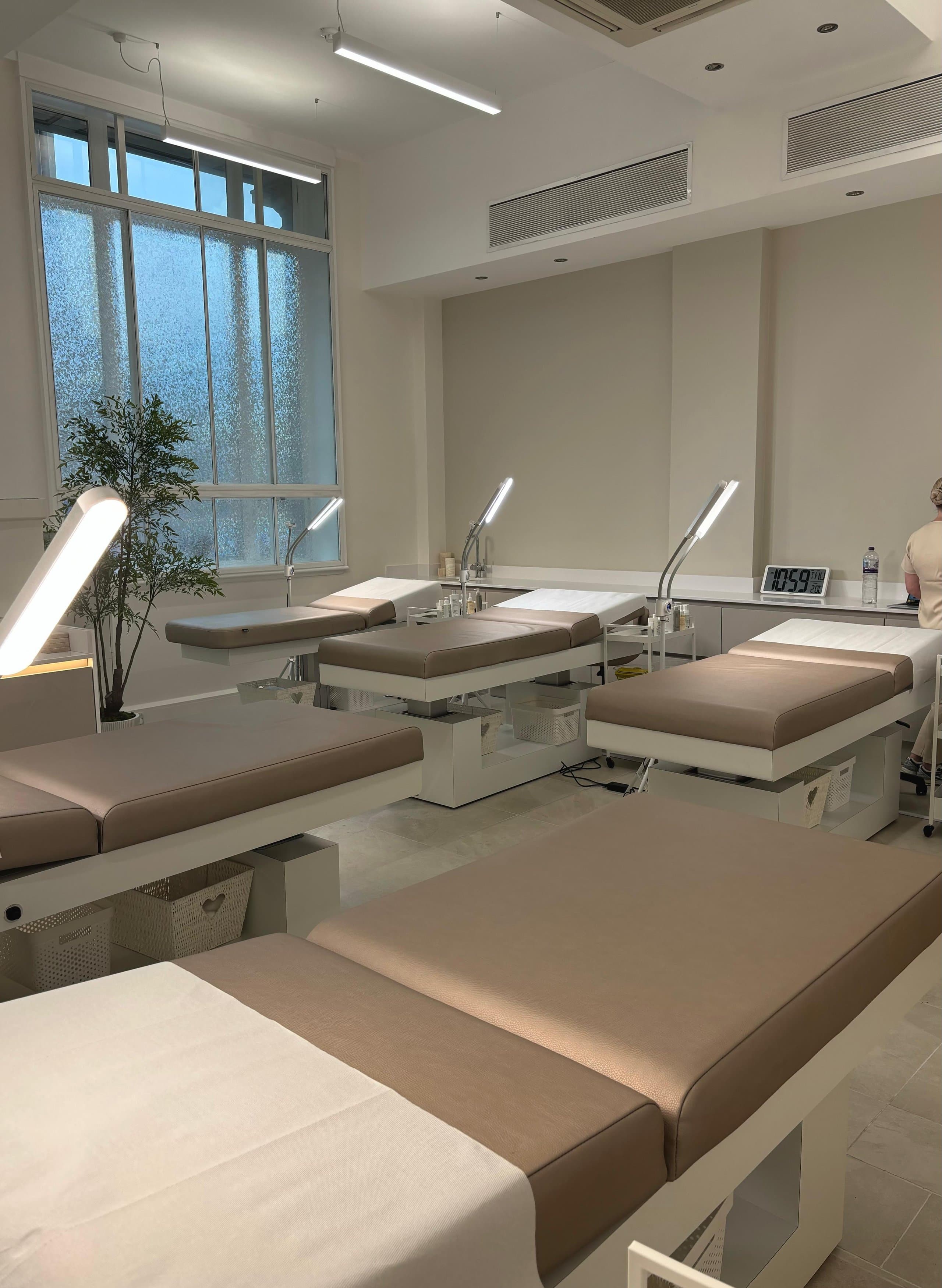

What is LED light therapy?
LED light therapy exposes the skin to specific, carefully chosen wavelengths of light from light-emitting diodes, at doses high enough to change how skin cells behave. No heat damage, no needles, no acids: just light, absorbed by the skin and used as a biological signal.
The proper name is photobiomodulation, and the idea has a serious pedigree: NASA-funded research into light and wound healing helped launch the field, and it now carries one of the larger evidence bases in aesthetic treatment. What makes LED unusual on a clinic menu is the combination of documented results and no expected downtime: nothing else in this library is simultaneously this gentle and this studied.
How light heals: the science, simplified.
Your cells contain light-sensitive molecules (chromophores), the most important sitting inside the mitochondria, the cell’s power stations. When light of the right wavelength reaches them, it’s absorbed and triggers a chain of useful events: energy production (ATP) rises, signalling molecules are released, circulation improves, and cells get on with their jobs faster, fibroblasts making collagen, immune cells calming inflammation, wounds closing sooner. That’s the mechanism described in the research literature, including the widely cited Harvard- affiliated review by Avci and colleagues.
Two practical truths follow. First, wavelength decides the job: different colours of light penetrate to different depths and are absorbed by different targets, which is why a proper device offers specific wavelengths rather than “nice warm light”. Second, dose decides the result: photobiomodulation needs enough light, delivered for long enough, at the right intensity. This single fact explains most of the gap between clinical machines and bargain gadgets.
The three wavelengths that matter.
Professional LED in the UK is built around three workhorse wavelengths, and once you know them, every LED menu makes sense:
- Blue, 415nm: the clarifier. Penetrates shallowly, which is exactly right, because its target lives at the surface: the porphyrins produced by acne bacteria absorb blue light and the reaction destroys the bacteria. A drug-free, touch-free acne tool.
- Red, 633nm: the rejuvenator. Reaches the dermis, where fibroblasts live, stimulating collagen production, easing redness and feeding that post-LED luminosity. The backbone of skin-quality and ageing protocols.
- Near-infrared, 830nm: the healer. Invisible to the eye and deepest-reaching, used for healing, inflammation and calming skin, and the reason LED has a genuine role after peels, microneedling and procedures.
Serious devices can combine wavelengths in one session, which is where protocol skill comes in: an acne client, a rosacea-prone client and a post-peel client should not receive the same light.
What LED treats.
- Acne. The flagship evidence: a randomised controlled trial in the British Journal of Dermatology found combined blue and red light produced a 76% mean improvement in inflammatory lesions over twelve weeks, outperforming benzoyl peroxide, with none of the dryness.
- Skin ageing and dullness. Red-light courses support collagen, soften fine lines and restore glow: gradual, natural-looking, and ideal maintenance between stronger treatments.
- Redness and reactive skin. Red and near-infrared calm inflammation, making LED one of the few technologies that suits even very sensitive skin.
- Healing and recovery. Post-treatment, post-procedure and compromised skin recover faster under near-infrared protocols, which is why LED is the professional’s favourite finishing step.
What it doesn’t do: replace structural treatments. LED won’t resurface scarring like a peel or rebuild collagen as aggressively as microneedling. Its genius is doing real, measurable good with no expected downtime, and making every other treatment work better.
Why MSTA uses Dermalux.
We use and recommend Dermalux in clinic, and the reasons mirror our Dermaceutic logic on the peels side: when a category is full of lookalike devices, choose the one engineered and evidenced like a medical instrument.
Dermalux is a British success story: designed and manufactured in the UK by Aesthetic Technology Ltd, and the name behind much of professional LED’s reputation in this country, with a shelf of industry awards to show for it. Its flagship Tri-Wave platform delivers the three clinical wavelengths (415nm, 633nm, 830nm) at tightly controlled accuracy, simultaneously where protocols call for it, and the MD model carries medical CE certification for indications including acne and wound healing: a regulatory bar most beauty-market panels never attempt.
In practice, that means the doses behind the published research are actually achievable in the treatment room, session after session. With light, the device isthe treatment, and this is the one we’re happy to put our name behind.
Clinic devices vs at-home masks.
The question every client asks, and it deserves a straight answer rather than a sales line. At-home LED masks from reputable brands are real devices: properly made, often FDA-cleared, and capable of genuine results. The difference is dose.
Consumer masks typically emit a fraction of a clinical machine’s light intensity, commonly tens of milliwatts per square centimetre against the 100–200+ of professional equipment, because unsupervised devices are quite rightly capped for safety. Less light per minute means longer, more frequent sessions for milder change: controlled trials of home masks show improvements that are real but modest. Add the things a mask can’t do, assess your skin, choose wavelengths for your situation, and adjust course by course, and the honest framing writes itself:
Results in clinic; maintenance at home. A home mask used consistently between professional sessions is a genuinely good combination. A home mask instead of professional care is a slower, gentler road that often quietly ends in a drawer.
A session, and the combination superpower.
An LED session is the easiest appointment in aesthetics: skin cleansed, eyes shielded, and then twenty to thirty minutes under the canopy while the light does the work. No sensation beyond gentle warmth, no recovery, makeup straight after. Courses are where the documented results live, typically several sessions weekly across a programme, then maintenance.
But LED’s quiet superpower is playing with others. It finishes a facial beautifully, calms skin after dermaplaning or a peel, and accelerates recovery after microneedling. For practitioners, it’s the rare add-on that improves the outcome of almost everything else on the menu.
Safety and contraindications.
LED’s safety profile is excellent, which is precisely why it must not be treated casually: the no-list is short but real. Professionals screen for photosensitising medication (some antibiotics, acne medications and St John’s Wort among them), light-triggered conditions such as certain epilepsies or lupus, active skin cancer in the area, and they protect the eyes in every session. Pregnancy is typically treated cautiously as a precaution rather than a proven risk. None of this is alarming; all of it is exactly why a trained consultation comes before the canopy.
LED in a skincare career.
For a skincare professional, LED is close to the perfect technology: evidence to stand behind, no downtime to manage, protocols that flatter every other treatment, and a client experience people genuinely look forward to. It slots in early, grows courses and memberships naturally, and it teaches an important professional lesson: read the research, respect the dose, and gentle does not mean ineffective. We teach it inside our Ofqual-regulated pathways as part of the complete, combinable skill set.
LED FAQs.
Does LED light therapy actually work, or is it a gimmick?
It works, and unusually for a gentle treatment, the evidence is solid: photobiomodulation has a substantial research literature, including randomised controlled trials. The classic acne study found combined blue and red light outperformed benzoyl peroxide over twelve weeks. The honest caveats are that results are gradual, dose matters enormously, and weak devices produce weak results.
How many LED sessions do I need?
LED is cumulative, like exercise. Professional protocols typically run in courses, often two to three sessions a week for several weeks, then maintenance. A single session gives a pleasant glow; the documented results come from completed courses.
Does LED hurt? Is there any downtime?
Very little of either. LED is non-invasive, most clients find sessions genuinely relaxing, and there's no expected downtime — occasional mild redness or dryness settles quickly. Proper screening still comes first: photosensitising medication, light-triggered conditions and certain eye conditions are excluded before anyone goes under the panel.
Should I just buy an at-home LED mask instead?
Home masks from reputable brands are real devices and do work, just more slowly and gently: their light output is usually more modest than a clinical machine's, though it varies widely by device — some current masks publish their outputs and carry small trials of their own. The sensible framing: consistent home use genuinely contributes, and supervised clinic programmes remain the stronger option. If you do buy one, consistency beats intensity.
Can I have LED after a peel or microneedling?
Yes, and you often should: accelerating recovery after other treatments is one of LED's best uses, particularly the red and near-infrared wavelengths. Many practitioners build it into the aftercare of peels, microneedling and dermaplaning precisely because it calms and speeds healing.
Where can I train in LED light therapy in the UK?
LED features within MSTA's Ofqual-regulated pathways at our Liverpool academy, taught alongside facials and the advanced treatments it combines with. It's one of the most accessible technologies for a new professional to add, and one of the easiest to integrate into an existing menu.
References and further reading.
The key sources behind this guide. As ever, where a claim is a manufacturer’s rather than independent, we’ve said so in the text.
- Avci P et al., Low-level laser (light) therapy (LLLT) in skin: stimulating, healing, restoring. Seminars in Cutaneous Medicine and Surgery (2013). (source)
- Papageorgiou P, Katsambas A, Chu A. Phototherapy with blue (415nm) and red (660nm) light in the treatment of acne vulgaris. British Journal of Dermatology (2000). (source)
- Sham-controlled trial of a home-use LED/IRED mask for periocular wrinkles (2025), illustrating the real-but-modest results of consumer devices. (source)
- Dermalux (Aesthetic Technology Ltd), Tri-Wave MD device and indications. (source)