
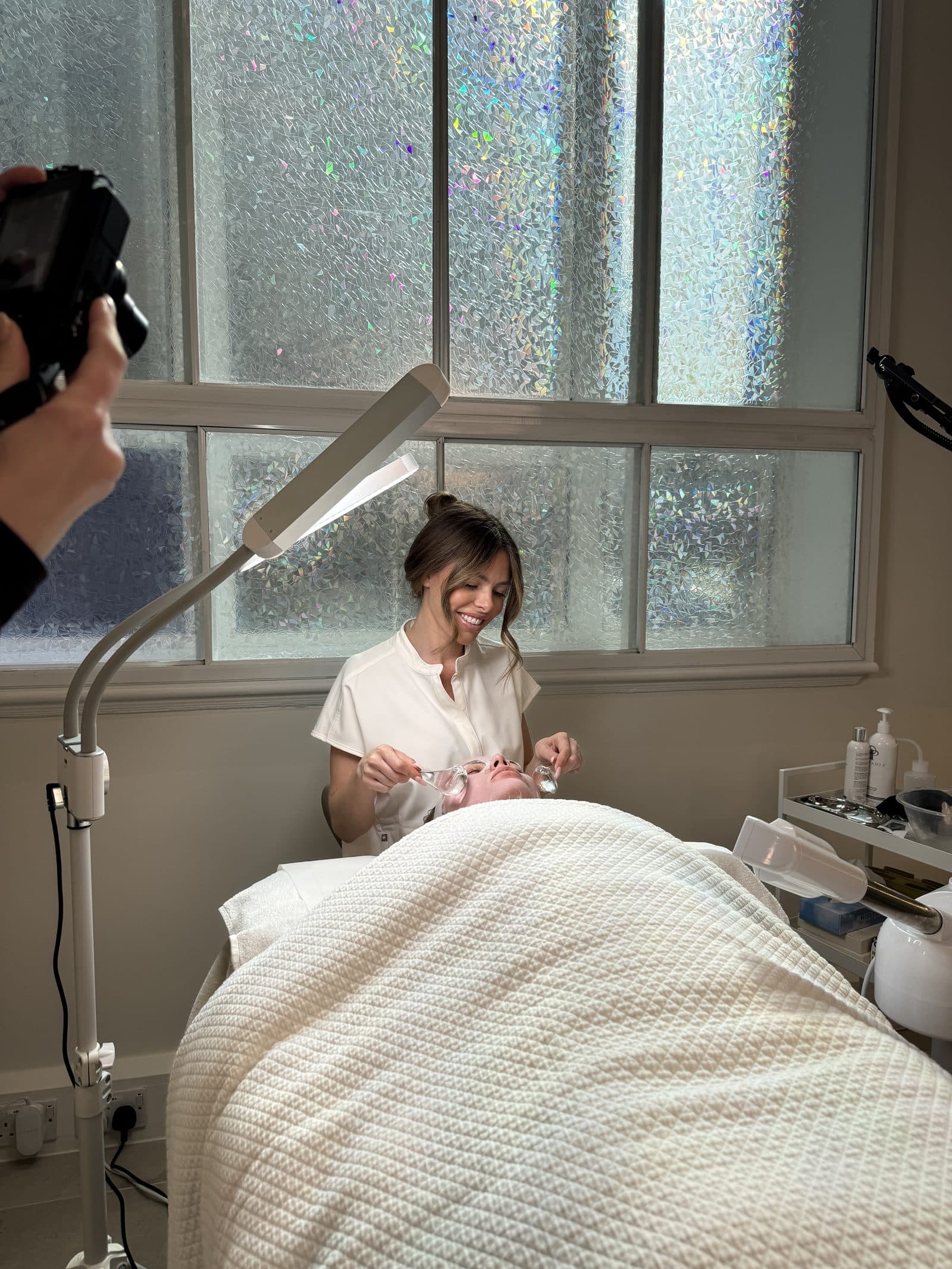
I get asked a version of the same question most weeks, usually by a student who is about to spend real money: “Kirsty, what would you actually buy first?” So here is my honest answer. The five pieces of technology I would carry out of the clinic in a fire.
One thing before we start, because it matters. This is technology only. Machines. Devices. Things that plug in. It is not the skincare products I can’t live without, because that is a completely different conversation and, if I’m honest, a much longer argument. We’ll do the products properly in their own article soon. Today is just the hardware.
And a health warning that applies to every single item below: none of it does the thinking. The best device in the world, pointed at the wrong skin, is an expensive way to cause a problem. Everything at Model Standards, our clinic on Chapel Street in Liverpool, starts with an assessment. Every machine on this list earns its place because of what it does after that assessment, never instead of it.
The list
- 1SkinPen. Microneedling.
- 2Dermalux LED. Phototherapy.
- 3Lumecca IPL. Light for pigment and redness.
- 4Morpheus8. Radiofrequency microneedling.
- 5Your phone, used properly. Photos and messages.
1. SkinPen
If I could only keep one machine, it would be this one, and I don’t even have to think about it.
It’s a motorised microneedling pen. A sterile cartridge of 14 tiny needles moves up and down thousands of times a minute, creating controlled micro-injuries in the skin. The skin’s answer to that injury is to repair, and repair means new collagen and new elastin, which over a course of treatments shows up as smoother texture, softer scarring, tighter-looking pores and finer lines. No heat. No chemicals. No light. Just the body doing what it already knows how to do, on purpose. We wrote the long version in our microneedling guide, so I’ll keep to why this pen.
So why SkinPen and not one of the hundred cheaper pens on the internet? In 2018 SkinPen Precision became the first microneedling device ever cleared by the US FDA, for facial acne scars in adults. A second clearance followed in 2021 for neck wrinkles, and the acne-scar indication now explicitly covers all Fitzpatrick skin types. That matters in a category where most devices have never been tested on anyone. In the study the FDA reviewed, nine in ten patients reported some improvement in their scars six months on. I’ll be straight with you: it was a small study. Forty-one people finished it, but only twenty of them were treated with the pen that actually went to market (the rest used an earlier prototype), so that 90% is twenty people’s own assessment, and blinded assessors saw improvement in just over half. Small and properly run still beats large and imaginary, and the company now points to more than ninety validation studies behind the device.
The first thing you notice in the room is that every cartridge is single-use and sterile, and once it has been used it physically locks out. It cannot go on the next client, even by accident. A sheath over the pen stops fluid travelling back into the device. Depth adjusts in 0.25mm steps from 0.25mm to 2.5mm, which is why the same pen works on a forehead, a cheek and a neck, and why we teach depth by zone rather than by habit.
It won’t tighten loose skin, because there is no heat. It won’t fix deep rolling scars on its own. And it isn’t for active acne, open lesions, anyone with a keloid history or anyone recently on isotretinoin. Expect a day or three of pink, tight skin afterwards, and plan a course, spaced four to six weeks apart, rather than one heroic session.
So why is it number one? Because it is the treatment my clients ask for by name, it is predictable, and a graduate can build a whole diary on it. That is also why we made sure MSTA became the UK’s exclusive SkinPen training partner. When something is this central to a career, you learn it on the benchmark device, from people who use it on real clients every week.
2. Dermalux LED
Every SkinPen treatment in our clinic ends under a Dermalux, and that is the whole reason it’s second on the list.
Three wavelengths: blue at 415nm, red at 633nm and near-infrared at 830nm. Blue is the antibacterial one, which is why it has a place with acne-prone skin. Red and near-infrared are absorbed inside the cell’s mitochondria, at an enzyme called cytochrome c oxidase, and the result is more cellular energy, less inflammation and faster repair. The word for this is photobiomodulation, and it has a real evidence base. In one of the studies I quote most to students, blue and red LED twice a week for four weeks reduced inflammatory acne lesions by around three quarters. And 830nm applied straight after a procedure has been shown to speed up recovery and calm the redness, swelling and bruising that make up most of a client’s downtime. The science is laid out in our LED guide.
We chose Dermalux because it is British, designed and built by Aesthetic Technology Ltd, and because the Tri-Wave MD holds medical CE certification for acne, wound healing, psoriasis and musculoskeletal pain. In a category full of lookalike panels, that regulatory bar is the difference between a medical instrument and a mood light.
Now the honest bit. LED is a supporting act. It doesn’t resurface, it doesn’t tighten, it doesn’t lift pigment. And the at-home masks everyone asks me about use the same colours at a fraction of the power. In phototherapy the dose is the treatment, so a mask is a nice top-up between visits, not a replacement for the panel. Check for photosensitising medication, protect everyone’s eyes, and take extra care with anyone who has epilepsy or light sensitivity.
It stays on the list because it takes twenty minutes, costs nothing per treatment to run, clients genuinely love it, and it lets me send a needling or peel client home calmer than they arrived.
3. Lumecca IPL
IPL is not a laser. It is a broad flash of light with a filter that cuts off the shortest wavelengths, and it goes after two things: the brown of sun damage and the red of broken capillaries and rosacea. Lumecca, InMode’s IPL, is the one we use in clinic, and the reason is power. By InMode’s own documentation it delivers up to three times the energy of a conventional IPL in the range where pigment and vessels absorb, and the practical effect of that is fewer sessions. We see meaningful change in one to three treatments where an older machine might have needed five or six.
It comes with two filters. The 515nm filter is for fair skin (types I and II) and superficial pigment and vessels; the 580nm filter is for light-to-olive skin (types III and IV) and slightly deeper targets. After a treatment the pigment darkens over a few days and then flakes away, and redness settles over a week or two. The research backs the redness side particularly well: a 2024 meta-analysis of four trials comparing IPL and pulsed-dye laser for rosacea found no significant difference in how often each cleared more than half the redness, but IPL was more likely to clear more than three quarters of it. The full picture is in our IPL and laser guide.
Now the limits, and I mean them. IPL is not for darker skin types (V and VI) or for tanned skin of any type, because the light cannot tell the melanin in a sun spot from the melanin in the skin around it. That is how burns and pigment changes happen. Melasma can get worse with IPL, not better. Photosensitising medication, recent isotretinoin and pregnancy all rule it out or need a medical decision. Everyone in the room wears eye protection, every time.
And one more thing before you buy one: in the London boroughs and a handful of other councils, premises offering IPL and laser need a special treatment licence, and wherever you are, your insurer will expect Core of Knowledge training plus training on the device itself. This is a Level 4 and beyond machine, not a first purchase.
4. Morpheus8
I’m going to say the unpopular thing first. Morpheus8 is not a facelift, it is not a silver bullet, and it is not right for everyone. Social media has turned it into a miracle, and every week someone arrives at the clinic expecting one. What it actually does is real, useful and modest.
The limits
Results build over months, not overnight, because you are waiting for new collagen. A course is usually one to three sessions, four to six weeks apart, with a few days of redness and grid marks after each. It will not fix severe laxity; that is surgery, and the numbers say so. In a 2010 blinded comparison using an earlier fractional radiofrequency needling system, fifteen patients who had a single session were graded against six surgical facelifts, and the RF session delivered roughly 37% of the facelift’s laxity improvement. Different machine, same physics, and the message stands. Useful. Not a facelift. A 2026 systematic review of 41 studies, 15 of them randomised, called the evidence for radiofrequency microneedling credible across its indications and skin types. Credible is exactly the right word. Miraculous is not.
It is also the wrong device for some faces. Go deep and aggressive on a thin face and you can lose volume you wanted to keep, because at depth it remodels fat. And it is off the table for anyone with a pacemaker or implanted defibrillator, in pregnancy, within six to twelve months of isotretinoin, with a keloid history, with metal implants in the treatment area, or with active infection, eczema or psoriasis where we would be working. The pigment risk is lower than with an ablative laser. It is not zero.
The science, and why we chose it
Morpheus8 is fractional radiofrequency microneedling. The needles are coated so the radiofrequency energy is released at the tip, deep in the dermis and, at the deeper settings, in the fat just beneath it. Each pass creates tiny columns of heat-coagulated tissue with healthy skin in between. The immediate effect is contraction; the lasting effect is months of remodelling, new collagen and elastin laid down around every column. At depth, that same heat tightens the connective tissue in the fat layer, which is how practitioners sharpen a jawline or soften a small pocket of fullness. And because radiofrequency works on water and tissue rather than colour, it can be used across skin types that IPL cannot touch.
We chose this device over the other radiofrequency pens for three reasons. Depth control first: the face handpiece reaches up to 4mm, the body handpiece goes deeper still, and the tips run from a 12-pin for delicate areas up to a 40-pin for the body, with a Burst mode that releases energy at up to three depths in one cycle. Second, the evidence and the regulator: in July 2024 Morpheus8 became the first fractional radiofrequency microneedling technology with an FDA clearance for soft tissue contraction. Third, the boring things that matter when a machine is your livelihood: InMode’s servicing, consumables and training. We give it a whole guide of its own in RF microneedling and Morpheus8.
It is right for mild to moderate laxity, a softening jawline, texture and acne scarring, in a client who has heard the limits and still wants the treatment. That client is very happy. The one who wanted a facelift for the price of a facial is not, and it is our job to tell the difference before the machine is switched on.
Morpheus8 does something real, useful and modest. I would rather you heard that from me than from a disappointed client.
5. Your phone, used properly
It costs less than anything else on this list and it gets misused more than all of them put together. It has two jobs in a clinic, and most people do both of them badly.
Job one is photographs. Same spot in the room. Same light: window light changes hour to hour and a ring light flattens the texture you are trying to show, so we use the magnifying lamp on a fixed setting. Same distance, same three angles (front, forty-five degrees, profile), hair back, no makeup, no filter, same phone. Do that and your before-and-afters are evidence. Skip it and they are lighting. We wrote about exactly this in why before-and-after photos don’t tell the whole story. And the legal bit, which is not optional: a photograph linked to a treatment is health data under UK GDPR, the strictest category. Consent to treat is not consent to post. You need separate, explicit consent for any marketing use, and the images belong in a secure record system, not your personal camera roll.
Job two is messages. A check-in the evening after a peel or a needling, again on day three, again on day seven. Reminders. Quick answers to the “is this normal?” question that every client has and half of them never ask. That five-minute habit is worth more to retention than any loyalty scheme I have ever seen. Use the business version of WhatsApp, keep clinical notes in your record system rather than in the chat, and answer in working hours. It is also, as it happens, how we now run enrolments at MSTA: no call to book, a real person on the other end.
What isn’t on the list
The steamer, the magnifying lamp, the skin scanner, the couch that goes up and down. All of them earn their keep, none of them would make me run back into a burning building. And you will have noticed there is not a single product here: no peel, no serum, no growth factor, nothing in a bottle. That is deliberate. Ask me about products and the answer changes completely, and it gets a lot more opinionated. That is the next article.
The thread running through all five is the same one that runs through everything we teach: assess first, then choose the tool. If you want to learn these machines properly, hands-on, on real skin, with a clinician beside you, that is what our VTCT courses and executive courses are for.
Lots of love,
Kirsty Xxx
Your questions, answered
Which device should a new skincare professional buy first?
If it is one machine, a medical-grade microneedling pen, and for us that means SkinPen. It has the deepest evidence base in its category, clients ask for it by name, and a graduate can build a full diary on it. LED is the sensible second purchase because it improves the results of everything else you do and costs nothing per treatment to run. IPL and radiofrequency microneedling come later, once your assessment skills, insurance and training are in place.
Is Morpheus8 better than SkinPen?
They do different jobs. SkinPen is mechanical microneedling with no heat: texture, scarring, pores and fine lines. Morpheus8 adds radiofrequency energy at depth for mild to moderate laxity and contour, with more downtime, more cost and more contraindications. Neither is a facelift. A good clinic uses each for what it is for, and often both on the same client at different points.
Can IPL be used on dark skin?
Not safely with a broad-spectrum device like Lumecca on Fitzpatrick types V and VI, and not on tanned skin of any type. IPL targets melanin, and it cannot tell the melanin in a sun spot from the melanin in the surrounding skin, so the risk of burns and pigment change rises sharply. Darker skin types are better served by treatments that do not rely on colour, such as radiofrequency, or by specific laser wavelengths in medical hands.
Are at-home LED masks as good as clinic LED?
No. They often use the same colours, but the dose is what matters in phototherapy, and consumer masks deliver a fraction of the power of a medical-grade panel like the Dermalux Tri-Wave MD, with no control over wavelength accuracy or distance. A home mask is a fine top-up between visits. It is not the treatment.
Do I need a licence to use IPL in the UK?
It depends where you practise. In the London boroughs and a handful of other councils, premises offering IPL and laser need a special treatment licence under local legislation. Everywhere in the UK, your insurer will expect Core of Knowledge training plus device-specific training before they cover you. Check both before you buy a machine, not after.