
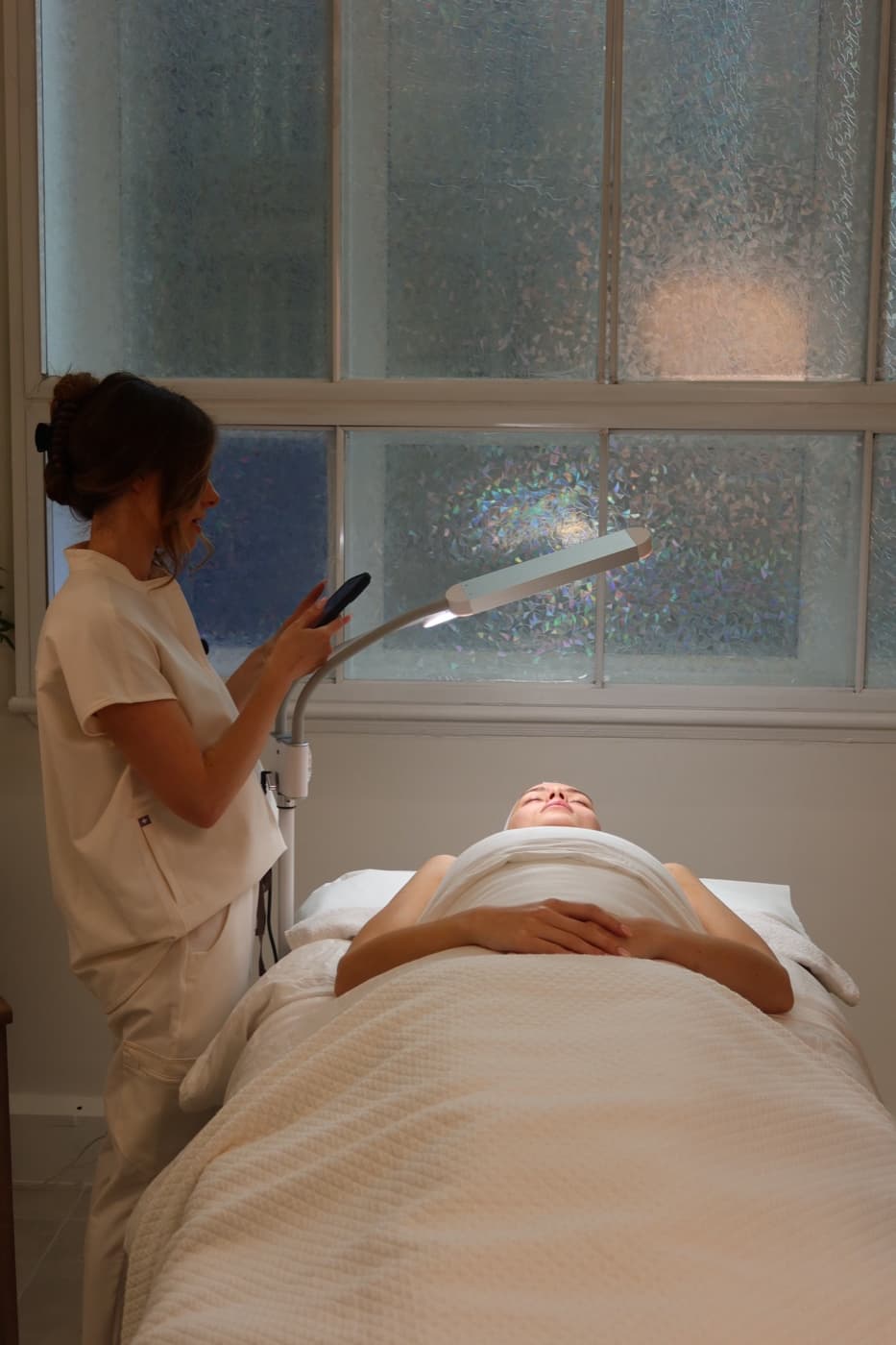
There’s a conversation that happens in treatment rooms all over the country, and it almost always begins the same way.
A new client sits down, opens her bag, and produces the evidence: a routine assembled from TikTok recommendations, dermatologist-adjacent Instagram accounts and a couple of genuinely expensive department-store purchases. Eleven products, perhaps twelve. Several of them excellent. Collectively, they’ve cost more than a course of professional treatments.
And her skin, by her own frustrated admission, looks exactly the same as it did two years ago. Or worse.
Her conclusion, understandably, is that the products don’t work, or that her skin is somehow beyond help. Our conclusion, after years of training clinicians and watching thousands of skin journeys succeed and fail, is rather different: the products were almost never the problem. Skincare has never had access to better formulations than it does today. Yet most attempted transformations still fail, and they fail for reasons that have nothing to do with what’s inside the bottle.
Here’s what’s actually going wrong.
Nobody ever diagnosed anything
Start at the root. Most failed transformations were never really planned: they were accumulated. A product for the breakouts. Something for the dark marks the breakouts left behind. An acid because everyone was talking about it. A retinoid because you’re supposed to. Each purchase a reasonable response to a symptom; the whole amounting to nothing, because nobody ever stepped back and asked the only question that matters: what is actually going on with this skin, and in what order should we address it?
That question is a diagnosis, and diagnosis is the entire reason professional consultation exists. Skin concerns have causes, sequences and dependencies. Treating pigmentation while the acne that causes it still rages is painting over a leak. Firing active ingredients at a compromised barrier is pouring water into a cracked glass. Without a diagnosis, even brilliant products are just expensive guesses, and a routine of twelve expensive guesses will lose to a routine of four correct ones every single time.
The barrier was broken before anything began
If we could teach the public one piece of skin science, it would be this: almost nothing works properly on a damaged skin barrier.
The barrier, the skin’s outermost defence, is what keeps water in and irritants out. And the modern, maximalist approach to skincare is spectacularly good at wrecking it: daily acids layered over retinoids, aggressive cleansing twice a day, exfoliating “for the glow” four times a week. The result is skin that stings when products are applied, flushes at nothing, breaks out in unfamiliar ways and looks paradoxically both oily and dehydrated. Sound familiar? That’s not “sensitive skin”. In a striking number of cases, it’s a barrier that has been under sustained assault for years.
Here’s the cruel irony: a broken barrier makes every product perform worse and irritate more, which convinces the owner they need stronger products, which breaks the barrier further. It’s a spiral, and an enormous number of frustrated skincare consumers are somewhere inside it. The first phase of a real transformation is often the least glamorous imaginable: several weeks of deliberate simplicity while the barrier repairs. Skipping that phase doesn’t speed the journey up. It guarantees the journey fails.
Consistency lost to novelty
The next culprit is the most human one.
Meaningful skin change runs on biological time. A skin cell’s journey to the surface takes weeks; collagen remodelling after treatment unfolds over months. Which means virtually every serious intervention (a corrective routine, a course of peels, microneedling) needs somewhere between eight and sixteen weeks of consistent execution before judgement can fairly be passed.
Almost nobody makes it that far. Around week three or four, precisely the point where the biology is working but the mirror hasn’t caught up, doubt arrives. And doubt, in the age of the algorithm, is immediately supplied with alternatives: a new hero ingredient, a new viral routine, a new treatment trend. So the plan changes. The clock resets to zero. And three weeks later, it happens again.
We call it treatment hopping, and it is quietly the biggest killer of results in this industry. The pattern produces a person who has, technically, “tried everything”, and completed nothing. Their bathroom shelf is a graveyard of week-three abandonments. It’s why the clients who get the results they came for are so rarely the ones with the most products or the biggest budgets. They’re the ones who committed to one correct plan and were, frankly, a bit boring about it. In skincare, boring wins.
Homecare was treated as optional
Now for the uncomfortable truth about professional treatments, uncomfortable for clinicians as much as clients.
A client’s skin spends roughly one hour a month in your treatment room and about seven hundred hours a month everywhere else. Whatever happens in that hour, however skilled, however advanced, is competing against everything that happens in the other seven hundred. The daily routine, the SPF worn or skipped, the sleep, the stress, the picking.
This is why homecare isn’t the retail bolt-on at the end of an appointment. It is half the treatment. Arguably more. Professional work creates the stimulus for change; homecare determines whether that change survives, compounds or quietly unravels before the next appointment. A course of peels supported by disciplined homecare and daily SPF produces a transformation. The identical course followed by sunbathing and a cleansing wipe produces a receipt.
Clinicians reading this: if your results are inconsistent between clients receiving identical treatments, look here first. The variable usually isn’t your technique. It’s the seven hundred hours.
Expectations were set by someone else’s lighting
Finally, the quiet one. Plenty of transformations that fail didn’t actually fail: they were simply measured against a fantasy.
The reference points most clients carry into a clinic were set by compressed, filtered, beautifully lit twelve-week journeys viewed in four seconds on a phone. (We’ve written before about why before and after photos don’t tell the whole story, this is that problem, viewed from the other side of the couch.) Against those reference points, real progress can feel like no progress: the texture genuinely refining, the flare-ups genuinely shortening, while the client sees only that she doesn’t yet look like the video.
Unmanaged expectations don’t just cause disappointment. They cause abandonment: the client quits a working plan at week six, becomes a treatment hopper, and the whole cycle above begins. Which is why setting honest timelines, photographing baselines properly and showing clients their own progress isn’t customer service. It’s clinical strategy. People stay consistent with plans they can see working.
Protocols, not products
Look back across those five failures and notice what they have in common. Not one of them is a formulation problem. They are failures of diagnosis, sequencing, patience, daily behaviour and expectation, which is to say, failures of protocol.
That word is the whole philosophy of this academy in miniature. A protocol is a diagnosis, turned into a sequence, executed consistently, supported at home, and measured honestly over a realistic timeline. It’s what separates a skin transformation from a shelf of products. It’s also, not coincidentally, what separates a professional clinician from an enthusiastic amateur: anyone can recommend a good product; a professional designs the system that makes good products finally work.
So if your skin (or your client’s skin) hasn’t changed despite genuine effort and real money, take heart. It’s very unlikely to be beyond help, and the answer is almost certainly not another product. It’s a proper plan, followed properly, for long enough to matter.
The products were never the problem. The protocol was missing. That’s fixable, and fixing it is the most valuable skill in professional skincare.
Designing protocols that actually deliver, diagnosis, sequencing, barrier work, homecare and honest measurement, is the spine of everything we teach at MSTA, from foundation level to advanced practice.